
Recently I hosted a live Q&A session for web designers, and I have to be honest with you – these are the kinds of conversations I live for!
Real questions. Real struggles. Real moments where someone is mid-project and doesn't know what to say, or they're staring at an old quote they gave a client eight months ago wondering if they have to honor it, or they're feeling like everything is changing so fast that they're not sure they even belong in this industry anymore.
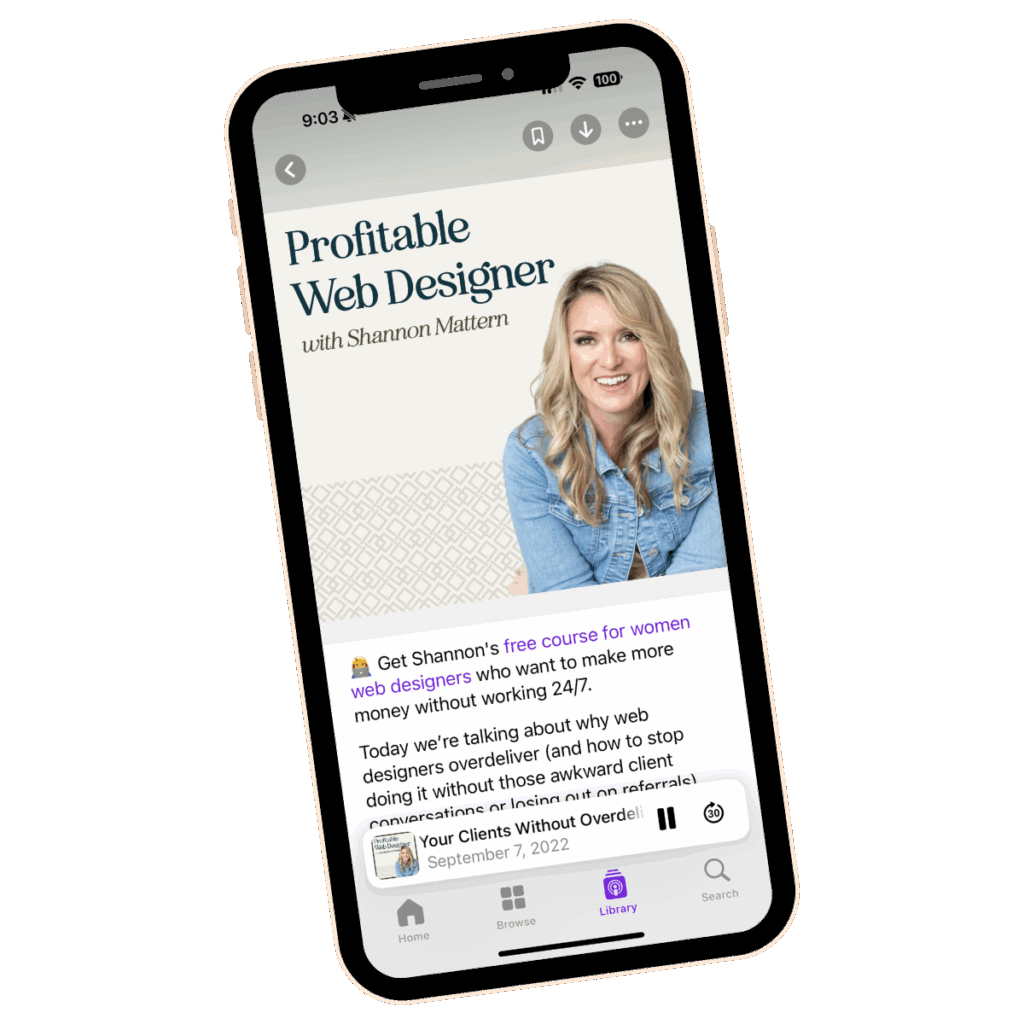
I answered six questions live that day, and I'm sharing the whole replay as Episode 201 of the Profitable Web Designer podcast. But I also wanted to write up the key insights here, because if you're running a web design business and you've ever felt any of this… this post is for you.
Getting Clients Without Feeling Pushy or Salesy
Hedera came to the Q&A with a question a lot of you probably have: she's been going to in-person networking events, having great conversations, but she can't figure out how to turn those conversations into clients. She's met people she genuinely wants to work with – but how do you go from “great to meet you” to “I'd love to work together” without feeling like you're using people?
Here's what I told her: stop trying to convert. Start focusing on connecting.
When you meet someone at a networking event who you think you could genuinely help, the next step doesn't have to be a pitch. It can be as simple as sending them a message that says, “I had some ideas when we were talking about your website – would you be open to me sharing them with you?” You're asking for permission. You're not forcing yourself on anyone.
And if you're not ready to ask that yet? Add value first. Can you introduce them to someone in your network? Did you read an article they'd find interesting? Did they write something you could share? Start there. Then when you follow up, you're not coming out of nowhere – you've already shown up as someone who gives, not just someone who wants.
We walk through all of this inside the Web Designer Academy – we call it Five Minute Marketing, and every week we look at one specific way to reach out to someone in your network that feels genuinely good and keeps you top of mind. The goal is always: add value and be willing to ask. Because the conversions come when the connection is real.
When a Project Becomes More Complex Than Expected
Chantel asked what a lot of web designers are dealing with: clients whose projects keep growing once you get into them, and you end up eating the cost because you feel like somehow it's your fault for not anticipating it.
Here's the thing – you're allowed to say something. You don’t have to eat the cost.
One of the phrases we use a lot inside the Web Designer Academy is: “say it like the sky is blue.” No drama, no apology, no guilt. Just: “This turned out to be more complex than what we originally discussed. Here are your options for how we'd like to move forward.” Then you give them choices – and none of those choices is you working for free.
But even better than that? There's a process that helps you avoid the surprises in the first place: free consultation, paid discovery, Package Matrix™. You do a free consultation to get a general sense of what the client needs. Then you offer a paid discovery step – where you go deep into strategy, ask all the questions, map out exactly what needs to be built, and present options for implementation. The client pays for that strategy session, and if they move forward with the project, that fee can be credited toward the work.
This process means you never have to say “I should have known better.” You get paid to figure it out, and your clients get a crystal-clear picture of what's involved before anyone commits to anything.
If you want to turn more of your proposals into higher-paying projects, grab our High-Converting Proposal Template to learn what to include (and what to leave out) to stop leaving money on the table.
Transitioning One-Time Clients to Ongoing Retainers
Ellie's question was about retainers – specifically, how do you move a client from a one-time project to ongoing work, especially when the client doesn't naturally see the need for it?
First: I want to take the pressure off. The goal isn't to “make” the client say yes. It's to give them information and choices and let them decide. When you're focused on finding the magic words that will convert someone, you're putting way too much pressure on yourself – and honestly, it can make your outreach feel weird to you and to them.
What actually works is planting seeds during the project – not waiting until the end to bring up retainers for the first time. This starts in paid discovery. When you're mapping out the strategy, you're not just identifying what's going to be built in this project. You're also identifying what gets to happen on an ongoing basis. You say, out loud, “These are things that are outside the scope of this project, but here are options for how we could work together on them after launch.”
Then when the project ends – and this is huge – you close it clearly. You don't just kind of finish and let things trail off. You say: this project is complete. Here's how to continue working with me going forward. And you give them a timeline to decide.
Women especially are often socialized to wait to be chosen – to wait for the client to ask us if they want more. I want to invite you to flip that. Make the offer. Ask if they're interested. You can do this in a way that feels completely natural and not pushy at all, and that's exactly what we teach inside the Web Designer Academy.
When a Referral Creates Awkward Client Dynamics
Anna shared a situation that so many web designers have been in: a client came through a referral from a friend, things got complicated, and she gave a price that was way too low. When the client came back months later asking for a quote, she wasn't sure if she had to stick with her original number – or if insisting on another call before re-quoting was being “too difficult.”
Let me be very clear: you are not being difficult. You are running a business.
You get to decide what your process is. And if you need a call before you can give an accurate quote, then that's your process. The client can either go through your process or they can find someone who doesn't have one. And if they choose not to go through your process, that's information.
The referral piece is the really tender part, though. Anna was worried she'd disappoint her friend if this client didn't work out. But here's a question I asked her directly: would your friend want you to take on a bad-fit client that makes you miserable? Probably not. Your friend who sent this referral almost certainly wants you to build a business that feels good – not one where you're absorbing costs and bending your process to avoid conflict.
Structure your process for you. Invite the client to come through it. And release the outcome.
Getting Visible Without Social Media
Ben is a brand designer who has realized that social media just isn't the right fit for how he works or who he wants to reach. He wants to work with film directors and authors, and he was wondering: is there a way to build a business and get clients without being tied to Instagram or TikTok?
Yes. Absolutely yes. And honestly, going direct is often faster and more effective anyway.
Here's what I'd do: find out where your ideal clients are already gathering in community with each other. What rooms do film directors go to? What programs or communities exist for authors? Who's building those rooms? Reach out to those people – the community builders, the event organizers, the coaches – and find ways to add value to them. This is the same strategy I used when I started my own business in 2014, before I had any kind of following. I reached out to women entrepreneurs I admired, asked if I could interview them for a series I was putting together, and created beautiful content that made them look great and that I sent to them ready to share with their audiences. Some of those relationships are still going strong ten years later.
You can also pitch yourself as a guest on podcasts that serve the audiences you want to reach. You can write for publications or blogs in those industries. Or, and this is one of my favorites from inside the Web Designer Academy Next Level Mastermind, you can build your own table. Create a community or event that brings the people you want to work with into the room – and invite them. You don't have to wait for a seat at someone else's table.
The key mindset underneath all of this: make the first move. Add value. And be passionately detached from the outcome – meaning you're willing to reach out, to ask, to hear a no or a non-response, and to keep going anyway. Because there is gold in your network. You just have to be willing to dig for it.
You Don't Have to Keep Up With Everything
Ariana shared something I've been hearing a lot lately: she's feeling overwhelmed by how fast things are changing – AI, accessibility, conversion optimization, all of it – and she feels like she owes it to her clients to keep up with everything. And if she can't, she's failing them.
Ariana, that thought is not true.
You cannot keep up with everything. And here's the thing – you don't have to, because that's not actually where your value lives. Your value isn't in already knowing every new tool or technique before your client asks about it. Your value is in knowing that you can figure out what you need to figure out for each client, in each situation, on each project.
When we think we have to come through the door already knowing everything, it creates impossible pressure. But the clients who are the best fit for you? They don't need you to know everything in advance. They need you to understand their goals and figure out what's required to get them there. That's it.
The fact that you care this much is already proof you're not failing your clients. The pressure you're feeling is coming from a belief about what you're supposed to be selling – and that belief is costing you so much unnecessary stress. Shift it, and everything gets lighter.
Rebuilding After a Break – You're Not Behind
Carly took three years away from her business. She recently moved to a new city, tried to reconnect with her old network, got one client, and has been struggling to build momentum since. She also told herself she's behind, that she missed out, that she has to catch up with everything that changed while she was gone.
Here's what I want to say to you, Carly – and to anyone else who's come back after a break and is feeling this way:
You are not behind. You are exactly where you need to be.
The design principles you knew three years ago still apply. The platforms you built on are still here. The skills you honed are still yours. What has not changed is your ability to figure things out – and you already proved that once by building your business in the first place.
The most powerful tweak Carly needed wasn't a new strategy. It was a tweak to how she was ending her outreach messages. Instead of: “Let me know if you might need this” – which trails off and gets ignored – it's: “Would you be interested in me taking a look at what we built together and seeing what updates might be needed?” Full stop. Question mark. A direct yes-or-no question at the end of every message is one of the smallest, most powerful things you can do to get people to actually respond.
And the story that you missed out, that you're behind, that you need to catch up? I want to invite you to let that go. Press the pause button on that story. Because believing it is exactly what's slowing you down – not the three years.
Resources Mentioned
Web Designer Academy programs:
- Web Designer Academy
- Next Level Mastermind
- 90-Day Shift Private Coaching
- Program Tour / Open House
- High-Converting Proposal Template (free)
- Get Clients with Website Strategy Sessions
Related Episodes:
- Episode #193: Stop Waiting for Referrals and Get Booked Out with Sarah Noel Block
- Episode #194: The Daily Habit For Building a Full Web Design Client Pipeline with Julia Taylor
- Episode #198: How To Make More With Less Web Design Clients
About Shannon Mattern
Shannon Mattern is a Pricing Strategist, creator of The Package Matrix™ and the founder of the Web Designer Academy, where she helps experienced women web designers book higher-paying web design projects, charge more with confidence, run projects without overworking and burnout, and break through to their next level of income and freedom.
Website: webdesigneracademy.com
Instagram: @profitablewebdesigner
TikTok: @profitablewebdesigner
YouTube: @profitablewebdesigner
LinkedIn: shannonmattern
What do I do when a web design project becomes more complex than the original quote?
You say something - calmly, without apology. You can tell the client something like: "This has turned out to be more involved than what we originally discussed. Here are your options for moving forward." Then offer specific choices that all work for you. No choice should involve you working for free. Scope changes are a normal part of client work, and communicating them directly and professionally is the right move.
How do I get web design clients without social media?
Go direct. Find the communities where your ideal clients already gather and reach out to the people who run those communities. Add value. Make introductions. Pitch yourself for podcasts in your niche. You can also create your own community or event to bring the right people into the room. Social media is one way to get visible - it's not the only way.
How do I transition a web design client to a retainer?
Start planting seeds during the project, not at the end of it. During your paid discovery phase, identify what ongoing support will look like and be explicit about it. When the project concludes, close it clearly and offer defined options for continuing to work together. Always give a decision timeline - retainer offers shouldn't be open-ended.
I took a break from my web design business. How do I rebuild?
Start with your existing network before building a new one. Reach out to past clients directly with a specific, concrete offer - not just "I'm available." End your outreach messages with a yes-or-no question. And challenge the story that you're behind - your skills didn't expire, and you don't need to catch up on everything before you start talking to people again.
Do I have to keep up with every new AI and technology change to serve my web design clients well?
No. Your value isn't in knowing everything in advance. It's in knowing how to figure out what each specific client needs for their specific project. You can't keep up with everything - and you don't have to. Your clients hire you for your judgment and problem-solving ability, not for pre-loaded omniscience.