
After reviewing some insightful takeaways from The Admin Bar’s 2025 Survey of WordPress Professionals and from SquareSpace’s State of the Web Design Industry Survey, I found myself curious about questions that weren’t asked or answered in either of those surveys.
So earlier this year, we decided to ask those questions, plus the ones I know freelance web designers are asking themselves all the time, the ones that can feel like a mystery when you’re sitting behind your laptop wondering if you’re “doing it right.”
We surveyed our audience of women web designers, including our community plus attendees of our Simply Profitable Designer Summit.
With responses from over 200 web designers around the world — most of them women in their 30s and 40s running full-time businesses — we were able to map out not just what respondents are charging, but also the mindsets, strategies, and patterns that separate those who are stuck in survival mode from those earning $75K+ a year.
The numbers are interesting, but the stories those numbers tell are even more interesting: the mindset gaps that keep so many women undercharging, the surprising limits of social media compared to word-of-mouth referrals, the untapped potential of recurring revenue, and the difference that charging for discovery can make.
My hope is that as you read these insights, you’ll recognize the spots where you’ve been playing small, see the levers you can pull to change that, and feel fired up to make a bold shift in your belief in what’s possible for you so that you can run the profitable, thriving web design business you deserve.
Watch our full podcast discussion on the pricing survey here 👇

Shannon Mattern is the founder of Web Designer Academy and the creator of the Package Matrix™ — a three-option offer framework she developed over a decade of working with thousands of women web designers who were talented, fully booked, and still underearning. Her pricing methodology is now used by service providers across industries, and she hosts the Profitable Web Designer Podcast.
Your pricing is not about you - how long you’ve been doing this, whether you’re self-taught, or what platform you use. It’s about the outcomes your clients get when they work with you.
Shannon Mattern

This report is based on 208 survey responses from web designers (freelance and agency owner), collected between March 2, 2025 – April 4, 2025.

Think of this report as a pulse check on the web design industry — a snapshot of what designers are charging, struggling with, and experimenting with in 2025.
The majority of respondents are female.
72% of respondents are in their 30s and 40s.
While most respondents are running their business full-time, a sizable minority are part-time or still building alongside other commitments.
The majority (58%) have been in business fewer than 6 years.
60% of responses came from the U.S., with additional voices from the U.K., Canada, and worldwide
In 2025, most freelance web designers earn under $50k annually, while about one-third make $50k+ (including 12% at $100k+). Men are more concentrated in the $75k+ band than women, and on average designers keep about 60% of revenue after expenses.
66% earn less than $50k annually; 34% earn over $50k+ annually; 12% report $100k+ per year.
No Data Found
No Data Found
66% earn less than $50k annually; 34% earn over $50k+ annually; 12% report $100k+ per year.
No Data Found
No Data Found
Men are more concentrated in the $75k+ band (26%) compared with women (18%).
No Data Found
No Data Found
Hover values represent percentages of respondents (without % sign)
The fastest path to increasing your revenue isn’t booking more clients at your current prices, it’s looking at the clients you already have and asking yourself where you’ve been undercharging and overdelivering. Ask yourself if you’re undervaluing what you do, and if you need a Pricing Mindset Makeover.
Sometimes the boldest shift you can make is simply deciding to price in alignment with the value you’re already delivering.
Annual revenue was fairly evenly distributed across the five revenue bands, with women more concentrated in the lower tiers and men more concentrated in the higher tiers.
Revenue gaps aren’t always explained by project pricing (men and women charge similarly per project) but by confidence, positioning, and mindset around value. For many, raising prices with existing clients can be more effective than finding more clients.
Women come into the Web Designer Academy saying, ‘No one is talking about what’s really going on underneath why I think I can’t charge more...’ Our mission is to show you why you can charge more, right now.
Shannon Mattern

Stop undercharging and start owning the value of your work. This guide walks you through pricing your services in a way that’s profitable and sustainable.
Get the Guide ⟶
Freelancers make up the majority of web design business owners (69%), with another quarter identifying as agency owners. ‘Web Designer’ is the most common role overall (77%), alongside Graphic Designer and Brand Strategist.
Freelancer is the dominant role (69%), followed by agency owner (24%).
No Data Found
No Data Found
Freelancer is the dominant role (69%), followed by agency owner (24%).
No Data Found
No Data Found
Agency ownership rises with revenue, reaching 44% in the $75k+ band.
No Data Found
No Data Found
Hover values represent percentages of respondents (without % sign)
Web Designer is the most common specialty (77%), with many respondents holding multiple roles.
No Data Found
No Data Found
Hover values represent percentages of respondents (without % sign)
Package pricing dominates how web designers charge in 2025 (82%), with only small shares using hourly, retainers, day rates, or other approaches.
Package rate pricing dominates at every revenue level, with hourly and retainer models making up less than 20% combined.
No Data Found
No Data Found
Hover values represent percentages of respondents (without % sign)
Package Rate pricing is the primary model at every revenue level, with Hourly Rate staying consistently low and other approaches making up only a small fraction.
The value of the package isn’t about what’s included in the package or how long it takes you to deliver it or how hard the work is, it’s about the outcomes your clients can create as a result of what’s included in the package. When positioned appropriately, packages allow you to more easily charge what a project is actually worth.
Over half (56.75%) of respondents charged an average of $2.5k-$9,999 per project; only 2.4% exceed $10k.
57% of projects fall between $2.5k–$9,999, while only 2% exceed $10k.
No Data Found
No Data Found
57% of projects fall between $2.5k–$9,999, while only 2% exceed $10k.
No Data Found
No Data Found
Higher-earning designers are far more likely to charge $2.5k+ per project.
No Data Found
This chart is best viewed on desktop.
Nearly all $75k+ earners (97%) charge $2.5k+ per project, compared with 25% in the <$10k band.
No Data Found
No Data Found
Hover values represent percentages of respondents (without % sign)
$2.5k-$4,999 is the most common price range per project, and the average project price generally increases as the revenue band gets higher.
The jump from $2.5k projects to $5k+ projects and beyond often happens when designers stop selling “a website” and start selling strategy, outcomes, and business results, and when they give their clients empowered choices in their proposals instead of yes/no options.
Your pricing is not about you. Once you stop making your pricing all about you — Squarespace or WordPress or Wix — and you just fully focus it on your clients, that’s when everything changes.
Shannon Mattern

60% of respondents reported selling at least a portion of their time hourly. Of the respondents that do charge hourly, the average hourly rate is $100/hr and the median is $92.75/hr.
Hourly rates rise steadily with revenue, from $76/hr in the <$10k band to $131/hr at $75k+.
| Revenue Band | Hourly Rate |
|---|---|
| <$10k | $76 |
| $10k–$24,999 | $79 |
| $25k–$49,999 | $103 |
| $50k–$74,999 | $111 |
| $75k+ | $131 |
The average hourly rate generally increases as the revenue band gets higher, indicating a positive correlation between overall business revenue and average hourly rate.

Feeling like you have to wait six months—or even a year—before raising your web design prices? That delay isn’t necessary.
Only 15% of respondents charge for strategy ahead of time, but they are more than 2× more likely to land $5k+ projects.
Only 15% charge for discovery, though over a quarter plan to add it.
No Data Found
No Data Found
Only 15% charge for discovery, though over a quarter plan to add it.
No Data Found
No Data Found
Designers who charge for discovery are twice as likely to land $5k+ projects.
No Data Found
No Data Found
Hover values represent percentages of respondents (without % sign)
As the average project price increases, a higher percentage of respondents tend to offer paid discovery, with the highest percentage in the ‘$5k–$9,999’ band. This indicates a correlation between offering Paid Discovery and higher priced projects.
Paid Discovery positions you as a strategist, not a pixel-pusher. It paints the picture of the long-term value for both you and your clients so that you’re not undervaluing and undercharging.
Most of you are giving strategy away for free… and you think you have to use the strategy to prove it’s worth paying you. But strategy is one of the most valuable things you do, and you deserve to get paid for it. Not only do you deserve it, it positions you to stop selling deliverables and start selling outcomes.
Shannon Mattern

Most designers run project-first businesses. Across all revenue bands, the majority report less than 19% of revenue from retainers or subscriptions.
Across all revenue bands, most designers earn less than 20% of income from retainers.
No Data Found
This chart is best viewed on desktop.
Even in $10K+ groups, around half earn <19% from retainers. The $75k+ tier shows the strongest adoption of recurring revenue.
There’s a huge opportunity here. Recurring revenue reduces the feast-and-famine cycle and frees up mental bandwidth, but many resist it because they don’t want to feel “on call.”
The solution is retainer agreements that set super clear boundaries so that you’re not providing first-class levels of service and responsiveness at bargain-basement prices… and then deconstructing your employee mindset so that your web design business stops leaking time and money.
Even looking at people making $75K plus, almost all of that revenue is still coming from projects. You’d expect more recurring revenue at that level, but the data shows otherwise.
Shannon Mattern
The majority of respondents offer Web Design, Graphic Design and Brand Strategy. WordPress leads overall as the top used platform, but a sizable share of respondents use Squarespace.
While present in all top 5 lists, Brand Strategy and Graphic Design show an increase in prevalence as revenue bands increase. Marketing Strategy is only visible in the top 5 list in the $75k+ bands, replacing SEO. WordPress is consistently a top platform across most revenue bands, maintaining a strong presence, especially in the $10k–$49,999 range.
Web design (87%) is nearly universal, followed by graphic design (65%) and brand strategy (59%).
No Data Found
No Data Found
Hover values represent percentages of respondents (without % sign)
<$10k Revenue Band:
$10k–$24,999 Revenue Band:
$25k–$49,999 Revenue Band:
$50k–$74,999 Revenue Band:
$75k+ Revenue Band:
WordPress leads at 61%, with Squarespace second at 38%.
No Data Found
No Data Found
Hover values represent percentages of respondents (without % sign)
<$10k Revenue Band:
$10k–$24,999 Revenue Band:
$25k–$49,999 Revenue Band:
$50k–$74,999 Revenue Band:
$75k+ Revenue Band:
Higher revenue bands correlates with offering more strategy-related services, such as Marketing Strategy and Brand Strategy.
WordPress and Squarespace are the top used platforms across all revenue bands, with Shopify and Wix alternating for third. Squarespace shows a notable increase in usage in higher revenue bands, becoming equally prevalent as WordPress in the $75k+ band.
This indicates that it’s not the platform that drives revenue… So stop charging less because it’s “so easy” for you to build a website on your chosen platform or page builder. Or stop thinking you can’t charge more because you’re not building from scratch. The value is in the outcomes and long-term results, not how challenging it was for you to build.
At the highest revenue band, Squarespace and WordPress are neck and neck. That tells us the platform doesn’t matter - it really is about the outcome for the client.
Erica Nash
Across all respondents, the biggest struggles are getting clients (66%), building recurring revenue (51%), selling services (43%), and pricing (42%). These challenges shift slightly with revenue.
Getting clients is the #1 challenge (66%), followed by recurring revenue (51%).
No Data Found
No Data Found
Hover values represent percentages of respondents (without % sign)
Lower earners struggle with getting clients, while higher earners cite team management and work/life balance.
No Data Found
This chart is best viewed on desktop.
Hover values represent percentages of respondents (without % sign)
Clients are all around you. Stop waiting for them to find you and proactively connect with people, let them know what you’re doing, and be open to allowing opportunities to come from anywhere.
Stopping overdelivering and overworking is a huge opportunity for higher revenue bands… they may be charging more, but they might also be working more and harder to justify their prices, or keeping prices low and piling on the clients. Taking a hard look at your money mindset can help you stop trying to justify your price by working harder.
Web designers say that getting more clients is their number one challenge. However, we see that higher revenue bands correlate with higher project prices. So is it really that you need more clients? Or is it that you need to be charging more for what you’re already doing?
Shannon Mattern

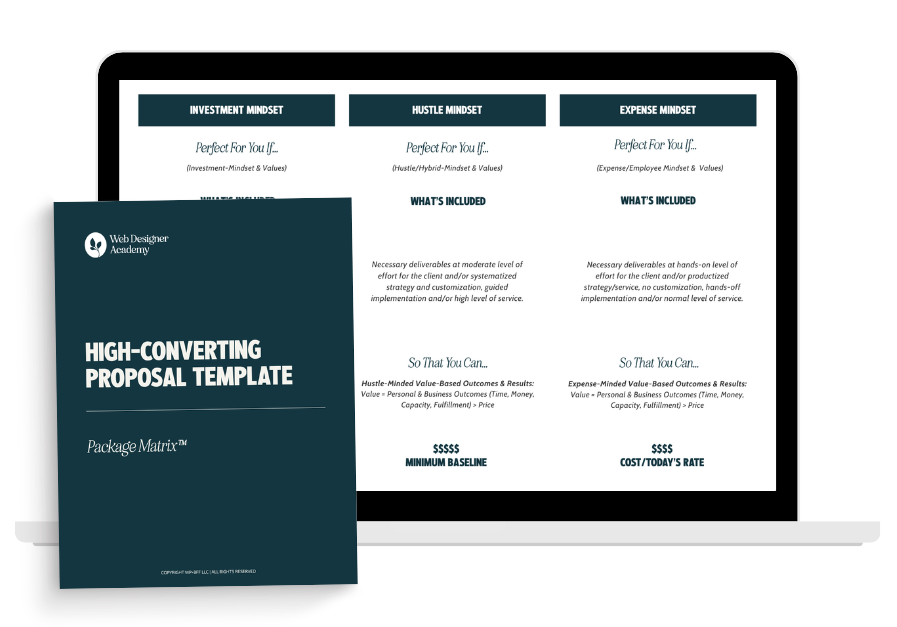
Your next proposal could be the one that changes everything. This free template shows you what to include (and what to leave out) to get more yesses at prices that feel worth it.

Discover the 5 subtle proposal mistakes even experienced web designers make that cost them thousands — and what to do instead.
Word of mouth dominates overall, and half of respondents are likely to include social media, in-person networking, and online networking.
Word of mouth dominates (91%), followed by social media (60%) and networking.
No Data Found
No Data Found
Hover values represent percentages of respondents (without % sign)
Higher earners are more likely to use social media, speaking, and podcast guesting.
No Data Found
This chart is best viewed on desktop.
You don’t have to wait for word of mouth, you can create it. Check out our Get Your Next Client Masterclass.
It’s not surprising that everyone’s using social, but nobody thinks that it’s working, because that’s where we live. Everyone just assumes, okay, I’m on social every day so my business should be on social every day. And the truth is, every business is different.
Shannon Mattern
Most designers invest their time heavily in word of mouth, social media, networking and SEO. But when asked what works best, the picture changes: word of mouth dominates, while all other strategies fall behind.
Word of mouth is both the most used (91%) and most effective (81%) channel by far.

Across all revenue bands, Word of Mouth is considered the most effective.
No Data Found
This chart is best viewed on desktop.
If you hate social media, permission to stop posting (or take it off your to-do/should-do list forever)!
“Word of mouth is the most effective thing, but simply word of mouth by itself is so passive. And if we’re wanting to get into those higher bands of revenue, it can’t be passive. So then how do we close that gap?
Erica Nash

No content hamster wheel, no social media burnout. This guide shows you how to consistently market your web design business in just minutes a week — even in a saturated market.
Over half (57%) of projects fall between $2.5k–$9,999, with the median in the $2.5k–$5k range. Only 2% of projects exceed $10k.
Nearly half (47%) report earning under $25k. About 34% earn $50k+, and just 12% report $100k+ in annual revenue.
Not on a per-project basis. Women and men report similar project pricing, but the gap appears in annual revenue: 26% of men earn $75k+ compared with 18% of women, while more women are concentrated in the <$10k band.
The median hourly rate is $92.75/hr and the average is $100/hr. Rates generally increase with revenue — from $76/hr at <$10k to $131/hr at $75k+.
Paid Discovery is a short, paid engagement that lets a client and designer map out goals, challenges, and a clear plan before starting a full project.
Yes. Only 15% of respondents charge for discovery, but they are 2× more likely to land $5k+ projects compared with those who don’t.
Recurring revenue is income a business earns on a regular, ongoing basis – such as subscriptions, retainers, or memberships – rather than one-time projects.
Not very. Across all revenue bands, the majority report less than 20% of income from retainers or subscriptions — even among $75k+ earners.
Strategy-focused services (like brand strategy and marketing strategy) become more common at higher revenue levels, while core services like web design remain universal.
Getting clients (66%) tops the list overall, while higher earners cite challenges like time management, work/life balance, and hiring more often.
