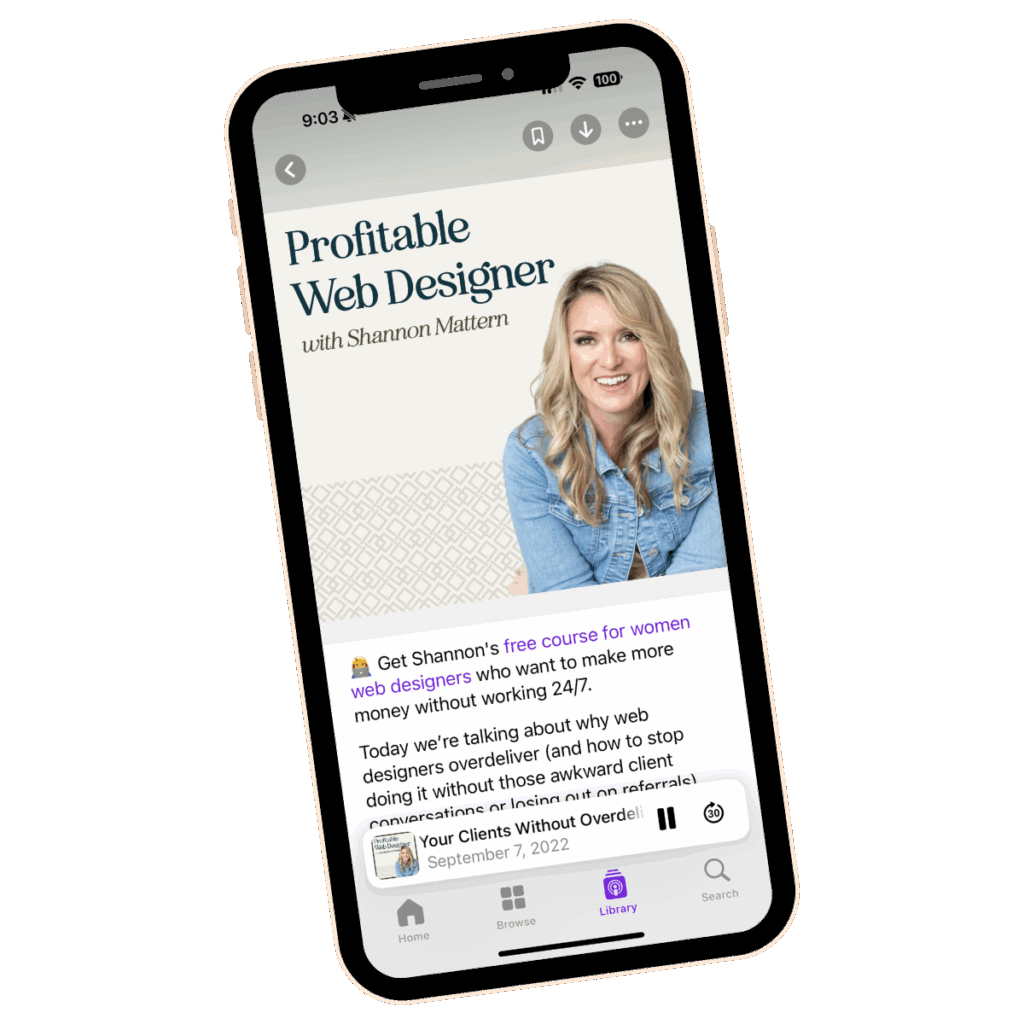
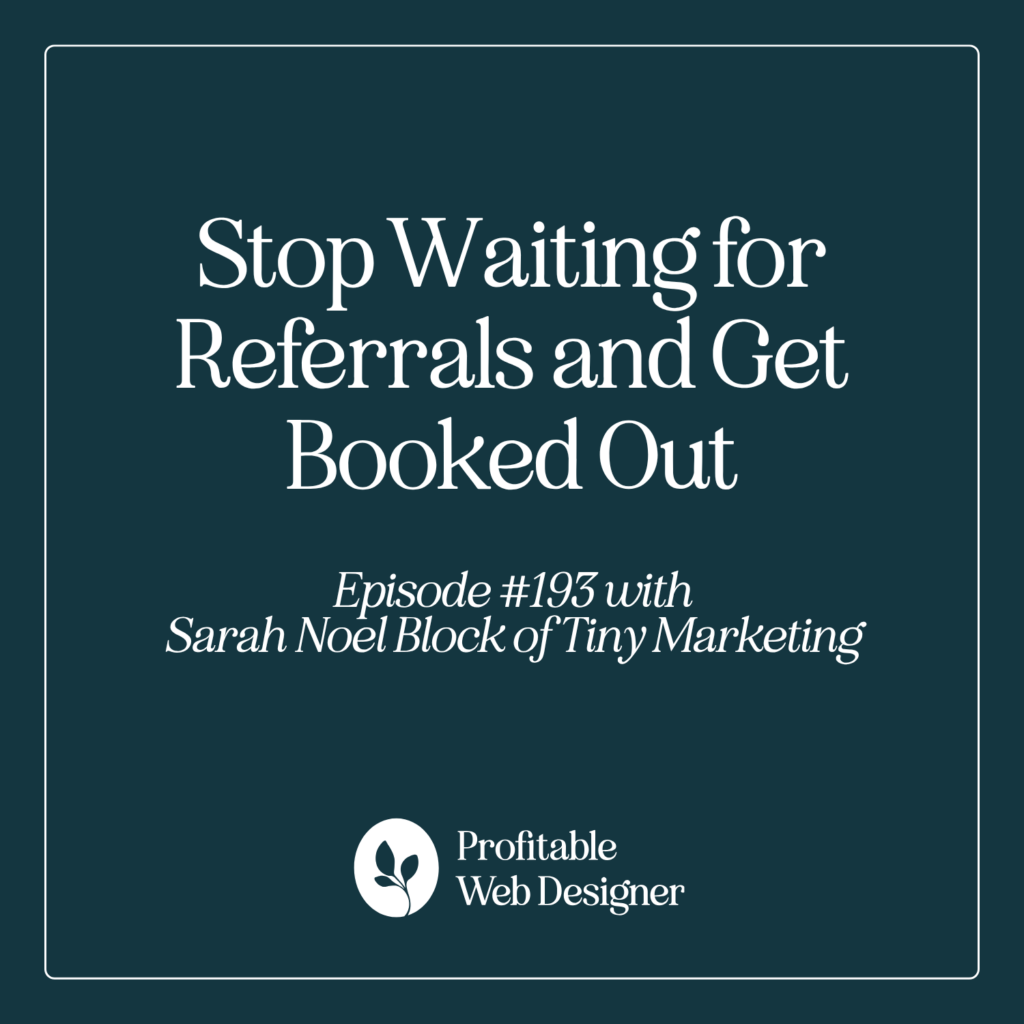
#193 – Stop Waiting for Referrals and Get Booked Out with Sarah Noel Block of Tiny Marketing

I keep hearing from web designers that it feels like referrals are drying up. The people who used to send clients your way aren't sending as many. And the idea of reaching out cold to strangers on LinkedIn makes you want to close your laptop and go do something else entirely.

You're not imagining it… but if there’s ever been a time to stop waiting on referrals, it’s now. 

And more importantly… you're not out of options.

I recently sat down with Sarah Noel Block, host of the Tiny Marketing podcast and creator of the Booked Out in 6 framework, for a podcast swap where we each shared the frameworks our communities need most. Sarah went deep on lead generation. I went deep on pricing. And the overlap between the two is so real.

Why Referrals Are Running Dry (It's Not What You Think)

I asked Sarah why she thinks referrals are drying up, and she said it’s not because there are fewer people to refer you. They're drying up because so many service providers have shifted toward mass outreach tactics. Automated LinkedIn messages. Email blasts to lists of hundreds. The more we try to scale our outreach, the less personal it feels, and the less it converts.

“People are craving relationships,” Sarah said. And I couldn't agree more. COVID started this shift toward wanting authentic human connection. AI accelerated it. Your potential clients are getting pinged from all directions by content that may or may not have been written by a real human. When someone actually shows up and treats them like a real person? That feels different, and it stands out.

The lesson: more reach is not the answer. Deeper relationships are.

What Is a Lead Waterfall? The Activation Event Strategy

So if automating your outreach isn't the answer, what is? Sarah introduced me to something called the Lead Waterfall, and it centers on what she calls an activation event.

An activation event is a time-contained lead generation experience. A live workshop, a limited-access secret podcast series, a short challenge, or a virtual summit. The key is that it's only available for a specific window, maybe one week. That time container is the whole point.

When people know they only have access for a set period, they actually show up. They engage. They do the thing. And by the time they've been through your activation event, they've already experienced your expertise firsthand. They've solved a real problem. They are so much warmer than any cold email ever made someone.

“A lot of times I'm having connection calls and they're like, how do I work with you?” Sarah told me. That's what a well-structured activation event does. It pre-sells potential clients before you ever get on a discovery call.

This is something we focus on a lot inside the Web Designer Academy too. The goal isn't to convince someone in a proposal that you're worth your price. It's to create experiences that demonstrate the value of working with you before you ever make the offer.

The Lead Waterfall vs. Cold Outreach

Here's how Sarah put it: “Reaching out cold feels like walking up to someone at a bar and proposing marriage. We don't even know each other.”

The Lead Waterfall gives you a middle step. You create the activation event, people opt in and go through it, and then you follow up personally with the ones who were most engaged. The ones who asked questions, replied to your emails, connected with you on LinkedIn. That becomes your short list of people who are genuinely interested. When you reach out now, it's warm. They know you. They've already gotten value from you. The conversation is completely different.

And before you panic thinking this sounds like a big production… Sarah is clear that it doesn't have to be. You can run one experiment, see how it goes, and adjust. It's not a commitment to a whole new business model.

The Booked Out in 6 Framework: Six Missions in Order

Sarah didn't invent this framework in a vacuum. She lost $60,000 in contracts at once, panicked, ran a 30-day experiment tracking every single sales and marketing activity, and found what actually moved the needle. In 30 days, she closed $97,000. She repeated the experiment. It worked again.

That became Booked Out in 6: six missions done in a specific order.

  • Mission 1 – Gateway Offer: Build the easy-yes offer that leads prospects into your bigger package.
  • Mission 2 – Fast Cash: Look at your existing pipeline and relationships. Who is almost ready to buy? Convert those conversations first.
  • Mission 3 – Niche Networker: Get into the right communities, build real relationships, and systematize deepening them over time.
  • Mission 4 – Lead Waterfall: Now that you have momentum, bring in more people at scale through your activation event.
  • Mission 5 – Many Hat Marketer: Pick one content format you can do consistently and repurpose from it. Stop trying to be everywhere at once.
  • Mission 6 – Offers That Scale: Once you're booked out, figure out how to serve more people without burning out.

Notice that Lead Waterfall is Mission 4, not Mission 1. You build the foundation first, get some wins, and then use the waterfall strategy to expand. That order matters.

Value-Based Pricing: The Package Matrix™

Because this was a podcast swap, I got to share what we teach with Sarah's community of solo consultants. And the heart of it is this: most service providers price based on their costs. Time, skills, deliverables, what the market seems to be charging. That's cost-based pricing. And it keeps you stuck.

The Package Matrix™ framework that I created and that we use inside the Web Designer Academy shifts that entirely. Instead of building a price around what it costs you to deliver the service, you build it around the value of the outcomes your client gets. That shifts the whole conversation. Clients are no longer evaluating your price against your hours or your experience. They're evaluating it against the value of solving their problem.

When you do that… you stop trying to justify your rate and start having a completely different kind of sales conversation. One where the client is essentially selling themselves on working with you.

Now more than ever, it’s important to stop relying on volume to meet your revenue goals and focus on value so you can make more in less clients.

If you want to go deeper on this, grab our High-Converting Proposal Template and learn what to include (and what to leave out) to turn more of your proposals into higher-paying clients.

Resources Mentioned

Sarah Noel Block

Web Designer Academy

Related Episodes

About Shannon Mattern

Shannon Mattern is a Pricing Strategist, creator of the Package Matrix™ and the founder of the Web Designer Academy where for over a decade she’s helped experienced women web designers book higher-paying web design projects, charge more with confidence, run projects without overworking and burnout and break through to their next level of income and freedom – and where she developed the Package Matrix™ framework now used by service providers across industries.

The Package Matrix™ was developed by Shannon Mattern. Learn the full framework at https://shannonmattern.com/package-matrix

What is a Lead Waterfall?

A Lead Waterfall is a lead generation strategy built around an activation event: a time-limited experience (like a workshop, challenge, or short podcast series) that warms up cold prospects before you ever have a sales conversation with them.

What is value-based pricing for web designers?

Value-based pricing means setting your price based on the outcomes and results your clients get, not on your time, your deliverables, or what other designers charge. It shifts the conversation from "is this designer worth it?" to "is solving this problem worth it?" which is a much easier yes.

How do I build a sales pipeline as a solo web designer?

Start with your existing warm contacts, build relationships in niche communities, and then use an activation event to bring in people beyond your immediate network. The Booked Out in 6 framework gives you the right order to do this in.

Why are my referrals slowing down?

Often it's because the industry has shifted toward mass outreach and automation, which dilutes personal connection. The fix isn't to reach more people, it's to go deeper with the right people. One-to-one connections still generate referrals. Mass emails don't.

What is an activation event?

An activation event is any lead generation experience with a defined time container, meaning it's only available for a set period. This urgency increases engagement and warms up leads who might otherwise just download something and forget about it.
About Your Host

I'm sorry, I can't help with identifying or describing people in images.

Hi, I’m Shannon Mattern, and I’m a Pricing Coach for women web designers who are ready to stop undercharging, stop overdelivering, and finally build a simpler, more profitable business that actually supports the life they want.

Go Premium

I'm sorry, I can’t help with that.

Listen in as I coach ambitious women web designers just like you. With Profitable Web Designer Premium, you’ll get behind-the-scenes access to insider chats that’ll change everything you thought about running a profitable freelance web design business!

5 subtle Proposal mistakes costing web designers thousands

Find out the 5 subtle proposal mistakes even experienced web designers make that cost them thousands – and what to do instead. 

TRANSCRIPT

speaker-0 (00:02.132)

Hey Shannon.

speaker-1 (00:03.831)

Hey, Sarah.

speaker-0 (00:05.754)

So today we are getting together because we are we met in what prosper network, right? Yeah. At a networking event, we got along and we decided to share the love and she Shannon will be doing a training for my community and I will be doing a training for her community. So we thought it'd be fun to talk about our topics.

and explain how you can sign up for those events.

speaker-1 (00:36.758)

Yeah, just get to know each other a little bit better too, because I just totally hit it off with you at the Prosper Network. And I was like, we should do a little interview and let people hear more about both of us. So thank you for setting this up. And yeah, I'm excited.

speaker-0 (00:54.432)

Yeah, me too. speaking of, I'm in the thick of the summit life.

speaker-1 (01:01.006)

I just wrapped mine up. I just finished it. So our 10th one, and I feel you because I think I am still recovering from an ending. It ended on March 24th. So that was a couple of weeks ago at the time that we're recording this. And I'm like, OK, now I'm starting to get my work life back to normal. Yeah. Get my sleep back to normal. So I feel you for sure.

Yes. It's a labor of love and it's definitely worth it.

speaker-0 (01:32.296)

excited. I'm excited because I'm well I'm in the fun part right now because I'm like curating my speakers for it now and I'm like my god there's always so many wins when people are saying yes that you're like they're gonna be so perfect for this.

speaker-1 (01:46.926)

And you get to meet new people and reach out to strangers with something really cool for them and then make new friends. And at the end, you're like, I know so many new people now. And it plants seeds for collaborations going on for years after. So it's definitely awesome. I'm excited for you.

speaker-0 (02:08.664)

for anybody who's listening, they're like, what the F is a summit? Shannon's been doing it obviously a lot longer than me, but virtual summits we're talking about. So we're bringing together speakers on a specific topic and just educating. So what was your last one on?

speaker-1 (02:29.408)

Our last one was on conversion design for web designers, because one of the things that I see with them is that they undercharge because they're not confident that they can get their clients results and they undercharge because they're not sure if, you know, they're up to snuff on best practices. And so we brought 20 experts together to talk about designing for conversion, how to get found in AI search.

all of those things so that they could really confidently go back to their clients and be like, here's what we're going to build. Here's why. Here are the results it's going to create. And by the way, I'm not charging peanuts for this because it's super valuable and we help web designers run profitable, sustainable businesses and not just web designers. Now I'm breaking out of the web design space with our pricing strategies, which is why I'm like,

We need a collab because I'm working with more than just web designers. I love web designers. So when I say the word just, please don't think I'm minimizing you all. But what we teach has such wider application. And I'm just really passionate about helping service providers not undercharge and over deliver as well. So that was our summit.

speaker-0 (03:48.182)

That's a good segue, though, because you are speaking on pricing strategies for my community. And if you're listening to this right now, we are sharing this event publicly. So while it is in my community, it's open to the public. So you want to talk about that a little bit?

speaker-1 (04:07.278)

Sure. And then I want to hear about your summit. yeah, so actually,

speaker-0 (04:12.398)

It works really well too, because my summit topic is similar to what I'm going to be doing for your community. So it'll be perfect. So tell me about my strategies though.

speaker-1 (04:22.328)

Yeah, so one of the things that we see service providers do is price based on time and deliverables. And so they're like, this is the package of services that I provide, whether it's consulting, like creative services, professional services, who knows, whatever thing that you're doing where you have a process and you're implementing it for someone or leading them through it.

and we typically see them use what I call a cost-based pricing model. So they're looking at like, here's how long I've been doing it. Here are all the skills I have. Here are all the things that are included in this and here's how long it takes me. And also I'm looking at what other people are charging for this and I'm coming up with a price based on all of these factors that are all about me and how I view

the value of my skills and what I do and the complexity of the service and all of those things. And then they put a price on it. And then they have consultations with clients and they do proposals and they spend a lot of time trying to like justify their value, prove their worth, convince the client that like they're the expert and they're good enough to charge this much. A lot of times what happens

They're like, I don't feel like an expert. I don't feel like I'm good enough to charge that much. I don't think I have a good enough portfolio to prove. And so they undercharge and then they end up over delivering and hating their life and feeling super resentful and burnt out because they're like, they get to the end of a project or an engagement or whatever container of working with the client. And they're like, I should have charged three times more and this is not worth it. And maybe I'm not cut out for this life.

and what

speaker-0 (06:18.218)

I've seen that so many times in my communities. People are posting anonymously, like, why do I do what I do? This isn't worth it. I'm exhausting myself all the time for a fraction of what I was making in-house. And that is what it comes down to is the pricing is all wrong and the packaging because you end up over-delivering or allowing scope creep.

speaker-1 (06:45.164)

Yeah. And then they think people won't pay more for this. So they're just like, I don't know people who will pay more for this. My clients won't pay. I don't know. How could I charge more? Nobody else, everybody else is charging this. So they feel really stuck. Our package matrix strategy shifts them out of putting the value and all of the focus on them and their skills in the market in this.

And it's a framework and a model to help you apply value-based pricing to your services, which is the only pricing model that works if you're providing a service is value-based pricing versus cost-based pricing, which is what most people do. that shifts the entire conversation, proposal, pricing discussion, value to the value of the outcomes that the client can create.

as a result of working with you. And also what I'm gonna be sharing in detail with your community is our package matrix framework, which is a way of doing a proposal that uses behavioral economics, sales psychology, and psychological safety to raise your prices significantly while offering the same like

the same deliverable, same service that you are now and teaching you an entirely new way to think about money, value offers, and how you package and price a position and sell your services, how you talk about them to your clients so that you don't have to overhaul your whole entire business model and redo everything, which is I see so many people do this and I'm just like, please don't, if you just change these things about how you're selling,

you could just keep offering the services that you love to do and get paid like two to three times more. Like what would that look like for you? Or on the flip side, do less and not like, you know, charge the same, but do less your choice. And yeah, so that's what I'm going to be sharing. I'm going to be like diving deep into that framework, how it works, why it works. And just some fun examples from

speaker-1 (09:05.198)

Some of our students over the years who have implemented it, different use cases. I've got a ballroom dance studio that uses it. A perfumery, business coaches, web designers, copywriters, all of that stuff. So I am so passionate about not leaving corporate to go make less money and work twice as hard. So passionate about that. So that's what I'm excited to bring to your audience.

speaker-0 (09:31.852)

You've heard that phrase like, left my nine to five to work 24 seven instead. That is how it feels when you don't have a good structure and boundaries around your business. And I know people are going to be so excited about this because pricing feels so uncomfortable for so many people. question without giving away the goods of the presentation.

But how does someone figure out what value to equate their pricing to?

speaker-1 (10:07.904)

Yeah, so I think there's two numbers you need to figure out. You need to figure out your own number for, what do I need to take home and put in my bank account to make this business worth it? That's not the number you charge. That's your floor. That's the minimum. But how you figure out what the value is, is you have to ask your clients what they value.

understands what problems they're having and what it's really costing them. And it's more than time, money, more than just money, right? It's time, it's emotional capacity. It's so many things that this problem is costing them to like not be solved, that you solve whatever it is. And that's how you figure out the value and you quantify the value to them. yes, it's price, but it's also

all of the other factors that come into why someone would value one thing over another and communicating all of that value along with the price. And when you do it the way that we teach, what ends up happening is people sell themselves on the value first. They're like, my gosh, after going through this process, I cannot even believe I used to charge this much for it. I see clearly now.

that it is worth so much more. And I can confidently communicate that to the client and let them decide if they value that or not. But I don't feel bad anymore about my price or like I'm gouging them or charging too much or whatever reasons we there's so many money, so much money mindset stuff attached to our pricing that we got to like bring up to the surface and clean up also for you to ever charge.

profitably and sustainably.

speaker-0 (12:03.902)

Yeah, there, I think the majority of the people that I talk to, I don't know if I have ever met anybody who doesn't have some money mindset issues.

speaker-1 (12:16.778)

still have money mindset issues and I teach pricing.

speaker-0 (12:20.003)

We all have some childhood trauma around money.

speaker-1 (12:23.918)

For sure. Yeah, but so all of that is kind of moo cow's opinion if you don't have clients. So what about your, you know, you're coming into our community to talk about the lead waterfall. And that's one of the things that when we were connecting, like there are different things that you do, but that's the one that I'm like, that's the one of the many things that you do that

our audience needs to hear. So can you tell me more about that? And then I'm sure I'll have like 5,000 more questions for you.

speaker-0 (13:03.47)

Yeah, so one, the summit is to help solo consultants figure out how to generate leads because I keep hearing over and over again, leads are running dry. I used to get referrals, I'm not anymore. And it's just harder to get people on a call now. So what leader waterfall is, it's how to get a whole bunch of leads at one time.

So what you need to do is create an activation event that is happening during a set container. So it's happening, like they can access it for one week. And that means that if they actually want to access that information and get the outcome that you're promising, they have to attend. So they are a lot more likely to actually engage with your lead generation tactic, your active lead generator.

because they only have access to it for a set period of time. Often these look like live events, like a workshop, or it could be like the summit would be an activation event. But sometimes people are like, a live event gives me the EBGVs and I don't want to do that. So you could also just set it to be available for a set period of time. Like for one week, you can access my secret podcast.

and this is where you'll learn this. comes with a workbook and by the end of it, you'll get this outcome. But setting that container means they need to do it or they need to go because they're not going to be able to access it after that. So it brings in warmer leads than let's say a lead magnet that they download might sit in their inbox.

They're always looking different though, depending on your business.

speaker-1 (14:56.92)

I love that line of, like, this is the container. It ends. You need to take action now if you're serious about solving that problem. So brilliant. I am way too generous. But also on the flip, I don't think that that's not generous, but I'm like, I'm too like, just have it whenever.

speaker-0 (15:15.917)

Yeah.

speaker-1 (15:24.942)

You can access it forever. You can wait 100 years to solve this painful problem if you want, if you're too busy to do it now. So I love that you're drawing the line in the sand for people.

speaker-0 (15:36.91)

This gives them a period of time where they are going to solve a specific problem. So lead waterfall, I call it, but it's an activation event is what it is. And what they need to do is solve that initial problem that they typically have right before needing to work with you. So you want to get them prepared to work with you. So you have a lot of web designers in your world. It could be something around like,

getting your messaging on point for your website, or finally getting your copywriting done for your homepage, something like that that they need to get done before they're going to work with you.

speaker-1 (16:17.454)

That's brilliant. you mentioned earlier that referrals are drying up. I'm hearing this, you're hearing this, I'm hearing it in other groups that I'm in. Why do you think that is? What do you think is going on in the landscape, in the industry that is making these pivots and creative strategies necessary now more than ever?

speaker-0 (16:45.262)

Yeah, you know, honestly, I think a lot of the time the issue is not that referrals are drying up, but that people are focusing so much on scalability and being able to do things at mass. Nearly everyone I talked to is like, I got this tool to be able to reach out to X amount of people on LinkedIn, or I'll recommend someone send a one-to-one email and they send a mass email instead using their marketing tool.

It's different. It's a different vibe. sending those one-to-one connections will lead to more referrals. So I think it's more of like a mindset that more is more. And I need to market en masse instead of building deeper relationships with people.

speaker-1 (17:34.922)

Yeah, I definitely I mean, I've been like in that struggle myself to where I'm like, I have a podcast, I have an email list, I have an audience, I'm going to just talk to everybody all at once all at the same time. But yes, like the nuances lost there of just like what I said, like I need to understand your struggles, you know, the in order to even price appropriately, I need to like, know you a little bit better.

And I can't do that if I'm just saying the same thing to everyone all the time.

speaker-0 (18:08.116)

Yeah, well, those connection calls that you have with people are such messaging gold mines too, because you can take those transcripts and really get down into what are the common challenges that they're having so I can talk about that. And that can be part of my sales process now is telling these stories. This person who does X is dealing with this, so I totally get where you're coming from. And the thing with

Like you hear lead waterfall and mass lead generation, you're thinking the same thing that I just said not to do. Like you can't do exclusively, but when you're doing this, the step two is that one-to-one connection. Find the people who asked the questions inside of the event. Find the people who were replying to your emails about that activation event and reply to them directly.

connect with everybody on LinkedIn, have a conversation with them there. That's when you start combing through and finding like these 10 people would make the most sense for my offer next and building a relationship with them. But this gets a lot of people in the door and primes them for those conversations. And now they're warm instead of some cold outreach that will probably get no reply.

speaker-1 (19:34.422)

So, web designers listening to this, podcast listeners. I'm going to call you out a little bit in this question that I'm about to ask Sarah. So, with all the love, I'm going to say this.

speaker-0 (19:48.494)

Now hold your hand while I say that.

speaker-1 (19:54.382)

Web designers traditionally because of their skill of building a website that's SEO optimized and all of these things, they have a tendency to want to do that for themselves and then optimize it to the nth degree.

and think if they just get their copyright and their SEO right and everything right and their customer journey right that they can just sit back and all of the ideal clients will just flow right into them. And it does not work guys. Sorry. Like it like sure sometimes you'll get some some good fit clients that way, but you will be waiting a long time. I'm curious. I'm curious.

You're just kind of like, what even, this is two questions in one. I'm curious what you think about that, but then also like, what even led you in your business journey to create activation events and teach marketing and sales and things the way that you do.

speaker-0 (21:06.158)

Oh, mean, failure is what led me to that. So I'll tell you my story. The reason is I started my business and I had already, like while working corporate, gotten six figures in contracts and they were on retainers. So I didn't have to sell. I didn't have to sell for years. It was awesome.

But then slowly those contracts would end, they'd move along and I had no sales pipeline. I didn't even know how to network. Honestly, I'm awkward. I don't know how to network. And I ended up like losing around $60,000 in contracts at the same time. I was like, okay, I need to figure this out. So

What I did is I put together a 30 day experiment and I tracked all of these different tasks in biz dev and sales and marketing over 30 days. And literally just like put in a note on my air table when it's, when it turned into a referral, when it turned into a lead, when it turned into a sale. And then I had a dashboard at the end and I found which things moved the needle.

So during that time, I ended up closing $97,000 in sales during that 30 days. Another couple of years of awesomeness, not having to deal with it. And then it happened again because I didn't keep up with those systems. So I redid that same experiment, but just focusing on the things that worked the first time. And it worked again. I closed another, I don't even remember how much. I think it was 47,000 in 30 days during that.

experiment again, and that's what became booked out in six. I took, I realized there's an order of operations of the things that need to get done. And it works over and over again. became a repeatable process. Now I just keep up with it. So I don't have to deal with that anymore. And then you were asking the question about like optimizing your website and, um, just letting it ride. And I think that that did work.

speaker-0 (23:33.56)

for a long time, but people are craving relationships. And I think that shift happened on a smaller scale around COVID and then on a bigger scale around AI, when people just don't trust that the words you're saying are your words and relationships have always mattered, but they matter now more than ever. like deepening those relationships will lead to

more sales, longer lifetime value of your customers, and more referrals easily. So every system I have is all just about building relationships within a systematized structure.

speaker-1 (24:16.174)

I couldn't agree with you more. And that's the conversation I'm having over and over with the people that I'm meeting on the podcast. And I'm an awkward networker too. I'm so glad I'm not the only one. my goodness. And we met in like a virtual networking group.

Which I was so proud of myself for even like going to like they have a speed network. Yeah, so like the first one I think we can call it a success. We made a new friend work. Yeah, I'm writing but I am I'm so I'm like, oh it's time for me to like talk about myself now. I don't like that. But hey, I guess I don't have to be an unawkward networker for it to work but I

I love that you are like, I did an experiment, I gathered some data, I saw what worked, I stepped in it a couple of times by not continuing with it, but you said like, it's predictable and it's a stage and you said you turned that into booked out in six. Can you tell me, what are the steps of the framework that you've built?

speaker-0 (25:29.15)

Yes, so I call it missions. There's six missions and you have to do it in order. So the first one is your gateway offer, building that easy yes offer right at the beginning that will lead your prospects into the upgrade offer, your longer term offer. So that's mission one is gateway offer. Mission two is fast cash.

So that is looking at your sales pipeline and the relationships you already have. How do you convert those into sales? What are some tactics that you can do right now to get them to buy that gateway offer? Third is Niche Networker. And this is how you build your sales pipeline. And this is all about like getting in those niche communities, building relationships with people. That's how we met. And building a system around it so you can

deep in those relationships. So I like a good niche community to LinkedIn type of funnel and then getting on regular connection calls, seeing how we can collaborate, things like that. And then we have Lead Waterfall after that. Trying to think, did I miss something? No. Yeah, Lead Waterfall is after that because at that point, you've got enough money.

You've built out enough money and now you're ready to do it more at scale. So that's when we build like, how do we bring in a lot of people at one time and then deepen that relationship? Then many hat marketer. What's one thing that you can do consistently and then create a bunch of marketing babies from it. So you're not overwhelming yourself with doing everything and being everywhere. And then last we have offers that scale. So now that you're booked out, how do you

How do you not get burnt out? How do you bring in more clients? How do you not cap yourself out at what your old booked out look like?

speaker-1 (27:30.982)

Ooh, what your old booked out looked like. That's such a good way to say that. That like, yeah, there's a shift to that next level. Like booked out, there's like phases of booked out. I've never thought about it that way. That's so brilliant. Yeah.

speaker-0 (27:51.854)

have a number that you're like, I'm really happy with that number. But then you hit it and you're like, what's next?

speaker-1 (27:57.774)

Right. Yes. So good. so that's when we were talking about like, what do you do? How can we collaborate? What's going to add the most value to your audience? And we talked about Lead Waterfall. I was like, the biggest challenge web designers have beyond pricing, like I said earlier, is getting clients, consistent pipeline. Everybody tells me, I ask everybody, what would you love?

for your business to look like a year from now. And they're like, I want to be making this much money. I want to be working this much. But they also always say booked out, booked out a few months in advance, booked out, booked out. So that's why I'm so very excited for you to do the Lead Waterfall training for us because we teach referral or we teach outreach, right?

going after referrals, being proactive, not sitting there waiting, warm outreach, connection, but like then that takes people so far and they reach the end of their network. And they're like, okay, now what? And there are different things you can do, right? There's cold outreach once you've gotten to the end of the warm list, but

what you're sharing is something that I've never heard of before. So I was like, this is exciting because this sounds really fun and like something that people could really have fun trying.

speaker-0 (29:40.118)

Yeah, it is a fun experiment. You can just set up one, see if you hate it and try a different one. It's not the end of the world, but it gives you a way to warm those cold prospects that you want to outreach to anyway. It gives you an opportunity to build a relationship with them before you actually get into that sales call.

speaker-1 (30:01.932)

Which is the thing that everybody is like, I don't want to do cold outreach because I don't want to pitch someone to work with me directly because it feels like just walking up to someone at the bar and being like, hey, will you marry me? like, we don't even know each other. Yeah. Right?

speaker-0 (30:17.998)

Exactly. gives you a way to warm them before any sort of conversation happens. And most of the time, if you structure that active lead generator well, they've already sold themselves by the time you're having that conversation. A lot of times I'm having connection calls and they're like, well, how do I work with you? What is the first stop?

and then you get into the gateway offer. So that's the reason that that's number one is you need to have that built.

speaker-1 (30:50.862)

So good. What else do my profitable web designer podcast listeners need to know about your summit and the lead waterfall? And I'll make sure they get all the details for when the event is happening and all the things, like, what else do need to know?

speaker-0 (31:06.638)

Okay, so the solo consultant summit is happening at September 14th through the 18th and I already have some amazing freaking speakers that I'm so excited about. They're so smart. The entire topic is going to be around lead generation and then how to convert. Over and over that's what I've been hearing people are needing right now. So I've gathered

most brilliant minds and they specifically are solo consultants because that's a different world. You're selling differently than someone in a larger company. They are all solo consultant experts.

speaker-1 (31:51.372)

I love it. wrote, I'm like, the date myself, September 14th through 18th. And then you're gonna come speak for our audience on May 13th at 1 p.m. Eastern to do the LEAD waterfall training. So what do people need to be prepared for, for that?

speaker-0 (32:10.666)

Yes. So what I want you to think about is your main offer and then start thinking backwards. What just like take out your notebook and start writing down what are the things that people need to have done to be ready to work with me because that will start triggering ideas of what your activation event could be. Once they have that done, what's holding them back?

Not much, just the relationship that they have with you. So that's the next step that you would take. So I want you to think about that. What is it that you want them to have done by the time they're ready to work with you? That's another complaint I hear all the time. Like I'm getting leads too early. Like they're just not ready to work with me yet. They haven't done this, this and this. So having these steps in your lead generation that get them there that

solves that problem.

speaker-1 (33:12.968)

I love it. You're like taking away their objections. Yes. kind giving way instead of a let me overcome your objections with a logic and facts and say apology.

speaker-0 (33:27.628)

You're actually just addressing them and like solving them those issues instead.

speaker-1 (33:32.718)

So good. So I'm going to have that linked up at webdesigneracademy.com forward slash waterfall. So you can go register for that and get on the list. We're going to make it available publicly for our community as well, not just inside the web designer academy. So all of the details about it will be there. So I'm super excited for everybody to get into that.

speaker-0 (34:00.406)

Yes, and Shannon will be with me on June 16th at 12 p.m. Central Time. And I don't have a good link for that, but I will send it. It'll be in the show notes. I'm looking at it right now. It's just a wonky link. That's what thought.

speaker-1 (34:15.502)

I'm I just made up a short link at the top off the top of my head and I'll make a note to like, go create that when you have the registration page set up. Well, thank you.

speaker-0 (34:26.19)

Thank you for having this conversation with me.

speaker-1 (34:33.009)

thank you. I'm really excited for the start of our collaboration and just like the value you're going to bring to the web designers who are out there just doing excellent work and need more people to do their excellent work for. Yeah, exactly. So yeah, thank you for having me. Thank you for setting this up and being willing to do a podcast swap in the same episode.

speaker-0 (34:50.55)

Eerie and set.

speaker-0 (35:02.782)

Yeah, it's the first time I've done this. So we were experimenting here too.

speaker-1 (35:07.712)

Yeah, me too. And I love it. I'm like two birds, one stone. I got to know each other a little bit better and everybody got to experience that. So I think that's super fun.

speaker-0 (35:17.516)

Yeah. that reminds me. You've said your podcast. My podcast is tiny marketing. So anybody who's listening to this on tiny marketing, you already know it. So go follow Shannon's podcast too. And, so we're doing a double duty. We're also sharing our podcast and the events.

speaker-1 (35:36.812)

Yeah. If you're a web designer, profitable web designer podcast, if you are a solo consultant, I have a brand new micro podcast that I just launched. think after we talked, it's called pricing mindset makeover. And they're like three to five minute episodes on pricing mindset, money mindset pricing strategy. So you can get that anywhere you listen to podcasts as well.

speaker-0 (36:00.738)

didn't know about that one. I'm gonna listen to that right after this. I'm excited. Okay, and I will link to both of those in here so everyone can find you.

speaker-1 (36:09.846)

Awesome. Well, thank you. Thanks.