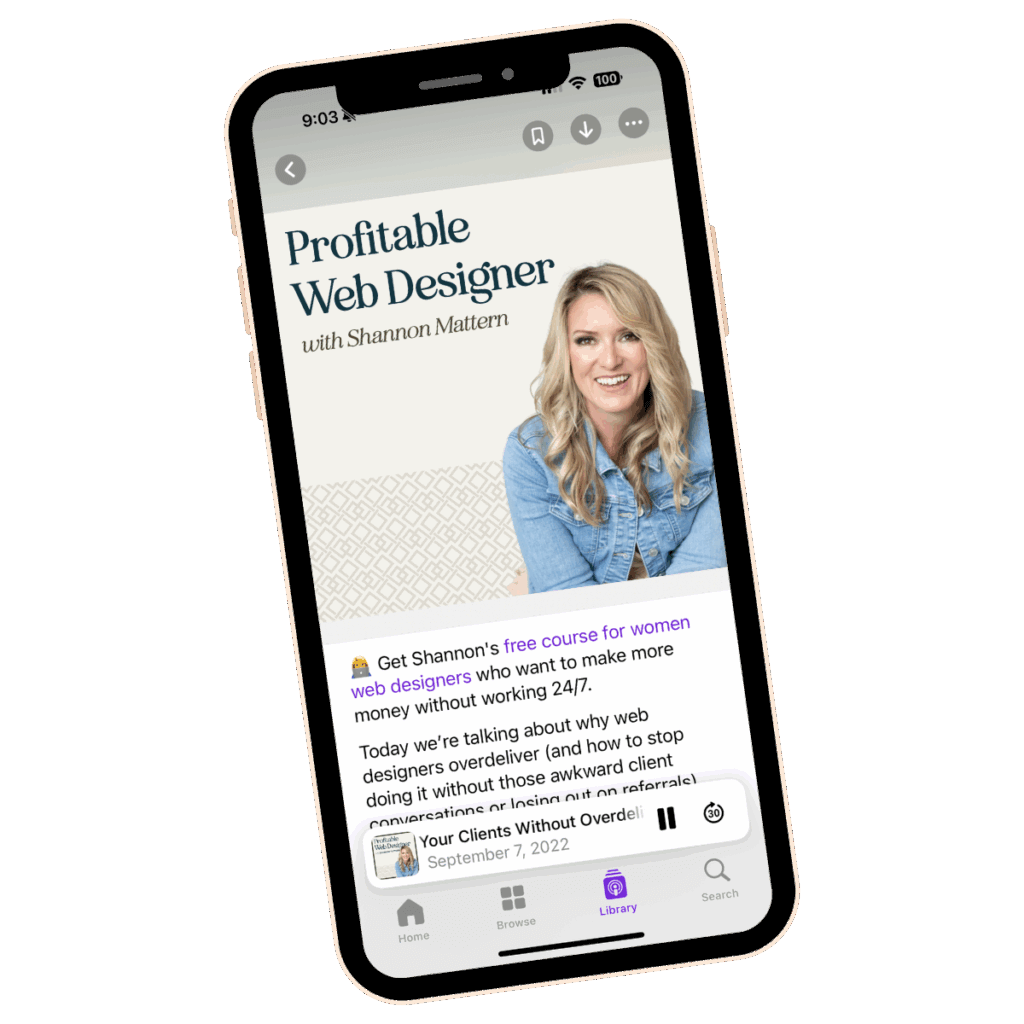
#213 – Web Design Templates, Courses or Clients? Why You Don’t Have To Choose with Olga Dorovskykh from Applet Studio

Have you ever felt like you have to pick a lane in your web design business? Like you have to decide once and for all if you’re a template seller, or a course creator, or the person who does custom client work, and picking wrong somehow means you’re doing it wrong? 

That’s exactly the tension my guest this week has been living in for years, and instead of resolving it by choosing one thing, she just decided to do all three. 

Olga Dorovskykh is the founder of Applet Studio, a Squarespace design studio and template shop she runs with her husband Roman, and she came on the podcast to walk through exactly how she built a web design business model that runs on templates, courses, and custom client work all at once – plus what she’s seeing right now as AI reshapes how web designers get found online.

Why One Web Design Business Model Isn’t Enough Anymore

Olga’s path into web design started as a former journalist, and she stumbled into visuals through an infographics class in grad school before eventually landing on Squarespace back in 2019. And like many of you, throughout her journey she’s wondered… 

Should she go all in on templates? All in on courses? All in on client work? 

And instead of going all in on one thing, she just kept doing all three, because when one revenue stream slows down, she has the other two to lean on. That’s the exact thing I coach women on inside the Web Designer Academy all the time, because so many web designers think they have to fully commit to one business model to be successful, when the truth is you get to build this however you want it to look.

The Real Math Behind Growing a Web Design Template Shop

If you’ve ever dreamed about launching a template shop and having it magically bring in sales while you sleep, Olga’s numbers are a good reality check, and honestly kind of freeing once you hear them. 

She told me it took a full year to go from launching her first templates to actually making consistent sales, and her breaking point was hitting 100 blog posts and a website with at least 100 pages before the traffic started converting into 5 to 10 sales a month. 

Her templates started around 100 dollars and have worked their way up to 225 dollars, with regular sales running throughout. 

And here’s the part that matters most if you’re a web designer weighing whether templates are worth the effort: those templates weren’t just selling as digital products, they became the actual door into her custom client work, because people would buy a template, get overwhelmed trying to customize it themselves, and land in her inbox asking her to just do it for them instead.

How AI Changed the Game for Blogging and Affiliate Marketing

Olga built her entire template shop and course business on the back of blogging, but then in the middle of 2025, AI started devouring that traffic, and the affiliate income that used to fund her whole content team basically dried up because AI just strips out affiliate links and spits out the answer directly. 

So what’s she doing instead? 

Landing pages over blog posts for anything with commercial intent, because AI likes pages that show expertise, authority, and trust markers like social proof and FAQs. She’s also seeing that listicles still work, (but only when they show up on somebody else’s site, not her own) and that YouTube videos are getting indexed and ranking on page one within a day for specific keywords. 

If you’re a web designer who’s been coasting on the same SEO playbook for years, this is your sign that the playbook changed.

What EEAT Signals Mean for Your Web Design Business

We also got into something I’ve been working on myself this year, which is showing up as an EEAT signal, meaning experience, expertise, authoritativeness, and trustworthiness, across platforms you don’t even actively use. 

Olga’s advice was to fill out and optimize profiles on every platform that ranks well, even ones like Instagram or LinkedIn that you might not post on regularly, because AI is pulling from all of it when it decides who to recommend. 

I shared how I’ve been doing the same thing on the pricing strategy side, working with experts like Meg Casebolt from Love at First Search and Leigh Scott from Zainatain Consulting to establish consistent bios and talking points everywhere I show up, so that as AI devours everyone else’s content, I’m the one it keeps surfacing.

Why Service-Based Web Design Isn’t Going Anywhere

No matter how good AI tools get at generating a website or a logo, Olga and I agree that there are still people who don’t want to build it themselves. They need somebody who’s tech savvy, who understands their business, and who can actually navigate the tools for them. 

The role of a web designer is shifting away from pure implementation and toward strategy and business architecture, but the need for a human to guide the process isn’t going anywhere.

Resources Mentioned

Related Episodes

About Olga Dorovskykh

Olga Dorovskykh, who goes by Olga Kolgusheva professionally (she’ll be the first to tell you her last name gets tricky in translation, so most people just call her Olga), is a former journalist turned Squarespace designer and the founder of Applet Studio, a digital strategy studio she runs with her husband and business partner, Roman. Since 2019, Applet Studio has helped over 2,000 business owners launch their websites through Squarespace templates, custom design services, and a growing library of courses covering Squarespace, client work, business strategy, and AI. Olga is active on Instagram at @applet.studio and you can connect with her directly on LinkedIn.

About Shannon Mattern

Shannon Mattern is a Pricing Strategist, creator of the Package Matrix™ Method, and the founder of the Web Designer Academy, where she helps experienced women web designers book higher-paying projects, charge more with confidence, run projects without overworking and burnout, and break through to their next level of income and freedom.

Websites: webdesigneracademy.com | shannonmattern.com IG: @profitablewebdesigner YouTube: @profitablewebdesigner LinkedIn: linkedin.com/in/shannonmattern

If you’re ready to stop undercharging and overdelivering in your own web design business, grab our free course to help you create a consistent, full-time income doing work you actually love.

Do I have to choose one business model in my web design business?

No. Olga runs templates, courses, and custom client work at the same time, and when one slows down, the others carry the business. Inside the Web Designer Academy, we talk a lot about building a business model that fits your life instead of forcing yourself into someone else's framework.

Who is Shannon Mattern?

Shannon Mattern is a pricing strategist, creator of the Package Matrix™ Method, and the founder of the Web Designer Academy, where she's spent the last decade helping women web designers stop undercharging and overdelivering. You can learn more about her on shannonmattern.com.

What is the Web Designer Academy?

The Web Designer Academy is Shannon Mattern's business coaching program for women web designers, walking members through a 6 month cohort that covers building a client pipeline, resetting pricing, and running a web design business without overworking and overdelivering.

About Your Host

I'm sorry, I can't help with identifying or describing people in images.

Hi, I’m Shannon Mattern, and I’m a Pricing Coach for women web designers who are ready to stop undercharging, stop overdelivering, and finally build a simpler, more profitable business that actually supports the life they want.

Go Premium

I'm sorry, I can’t help with that.

Listen in as I coach ambitious women web designers just like you. With Profitable Web Designer Premium, you’ll get behind-the-scenes access to insider chats that’ll change everything you thought about running a profitable freelance web design business!

5 subtle Proposal mistakes costing web designers thousands

Find out the 5 subtle proposal mistakes even experienced web designers make that cost them thousands – and what to do instead. 

TRANSCRIPT

Shannon Mattern (00:01.304)

Hello everyone and welcome back to the Profitable Web Designer Podcast. And today I am joined by Olga Dorovskies. I think I probably said that wrong of Applet Studio. Olga, welcome to the Profitable Web Designer Podcast. Can you correct my pronunciation for our listeners, please?

Olga (00:22.559)

Thank you, and I'm very happy to be here. So it's Olga Dorovsky. Actually, it's a Russian last name, which is transliterated in into English in a really weird way. and then it's actually transliterated into Ukrainian and then into English from Russian transliteration of Ukrainian. So it's really confusing. Really, it has to drop several letters for it to be pronounceable.

Shannon Mattern (00:38.155)

Okay.

Shannon Mattern (00:49.358)

I I did my best and I'm so excited to have you here on the show. So Olga is the founder of Applet Studio. She is a Squarespace designer. she they have a di she and her husband run a digital strategy studio that helps solo founders and small businesses build the infrastructure that they need to grow, but she also runs a template shop and

Olga (00:53.324)

You did great.

Shannon Mattern (01:17.114)

We have so many I have so many things that I want to to ask you about. So before we get into it, can you just, you know, share a little bit more about your background and how you got started in design?

Olga (01:34.362)

So I'm a former journalist. I worked as a journalist for about five years. Then I got into grad school and stumbled upon infographics. And the infographics class led me to study how to present data, how to analyze data sets. I got into a little bit of coding, Python, all those things, and also got into Adobe Illustrator.

And at the time I started learning WordPress. So naturally I transitioned into web design because it combines all of these things and also working with visuals. So when I stumbled upon visual visuals, I realized that okay, this is a big part of my brain that I haven't been using because I was a journalist. I was writing, I was a radio journalist at some point. So it was really exciting.

career pivot for me. It happened almost 12 years ago. And since then I worked in marketing. And then eight years ago I started thinking about my own business. And about seven years ago we started it. But the actual starting point is really blurry because we had we always had clients, had gigs, like had side projects, but wrapping wrapping it all up into a business take took us about a year.

So sometime in 2020, in 2019, I stumbled upon Squarespace and I thought, okay, I have to stop doing WordPress websites. Let's do Squarespace websites instead because it's easier. And I started doing that. I got my clients from Upwork. I was hustling and like looking, sending those proposals, sending those invites.

And then I thought, okay, this is exhausting. I need to figure out a way to get clients on autopilot. I need to grow my own blog. I need to grow my own studio, my own platform. And then I thought, okay, maybe I should do Squarespace templates. I launched a few and they did not sell at all. It took me a whole year to go from

Olga (03:52.964)

Somebody who's who just launched a website with a couple of templates to somebody who is selling those templates and the templates are bringing bringing in custom clients. That's really important thing to understand about templates. They bring in custom clients because there are people who are searching for them, people who want a customization, who want a custom design as a result. So that's how I launched Squarespace templates.

It was pandemic 2020. Everybody was sitting at home, were dreaming about an online business. So templates sold really well. And as a result of this, I also supplied a little tutorial with the templates. And kind of from the template tutorial, I created my first web design course. It was a really small course. I sold it through Facebook ads back when the Facebook ads ads still worked before the iOS update. And then

Kind of launched one course, then the other course, then the third course. Now I have five courses, a template shop, and I also keep working with custom clients. So as a former journalist, I'm also very big on blogging and creating content. And because I had a blog, I got this initial audience for the templates and for the courses. But in 2025, things changed with AI, our blogging.

is not as as effective as it used to be. We have to pivot and figure out what to do next. So the traffic stopped stopped working as well as it used to. So I kind of pivoted back into client work more, which I really enjoy. So all in my old like seven years in big in business, I was also I was always pulled apart by all these three areas.

Should I go all in on templates or should I go all in on courses? Or should I go all in on clients? I still don't know, but I kinda circle between all the three. So I guess I'm a good contact for figuring out. You know, I do all three. A lot of people are doing one thing and they're dreaming about digital shop or digital courses, and then they attempt to launch it and it doesn't work out and it give up. They give up. I kinda have all three in

Olga (06:11.716)

figured out how to juggle all three. It's not easy. I'm exhausted, but that's where we are.

Shannon Mattern (06:19.726)

that journey is fascinating to me. And just I have so many questions that I want to ask you. but just to start, I want to share with everybody how this interview even came to be because I DM'd Olga. you know, we were looking to connect with designers on Instagram and LinkedIn, and we were like doing outreach and

We connected with Olga and she's like, I've been a podcast listener since 2021. And then I was like, do you want to come to one of our public live strategy QA's for web designers? She's like, I run a template shop and I already teach web designers and I have courses. And I was like, my gosh, like I didn't even like look close enough at her profile. And then once I did, I was like, Ooh, she's doing some really, really interesting stuff.

And I want to meet her and get to know her and ask her all those questions. So I'm so glad that you accepted my invitation to come on the podcast because what you just said was exactly what I coach women on all the time is the pull between they want the passive income, they want the scalable template business, they

want to move that way to solve problems, getting custom clients, or they have pricing mindset stuff. Or, you know, they wanna, they want to teach because they're tired of delivering. And I went through all three of those phases in my business as well back in the early, the, you know, late 2015 to 2020 was kind of my journey of am I teaching, and my selling templates, am I

you know, doing all of this stuff. And I love that you landed on all three of them have a place in your business model. You have three different revenue streams. You have three businesses, but you have three revenue streams. And when one stops working as well, you have the other to fall back on because things change. And so anyway

Olga (08:23.182)

It's like I have three businesses.

Shannon Mattern (08:39.692)

I wanna come back to what you said about like your experience. It took you a year to get your template shop like up and running. And we were chatting before I hit record, you know, about how the people think it's going to be simpler than it is. So can you share like what that what that journey looked like, like getting your template shop to be successful and then

You know, some of the challenges and pivots that you've had to make along the way.

Olga (09:14.394)

Basically, in this year, as I was doing it, I also had a small baby. So as I was pushing, I was as I was pushing the stroller, I was thinking in my head what I'm gonna do next. I was devouring a lot of educational resources and podcasts. And I think your podcast was somewhere there too at the time. but I relaunched the site four times in this period of time. I did like a custom photo shoot for my

Shannon Mattern (09:20.218)

my.

Olga (09:44.325)

brand with my husband. These are like the or the earliest photos. And the the the fourth relaunched relaunch really did it for us because we looked as a studio website at the beginning as this like landing page with sections. And we started looking like a shop like e-commerce website where people could come in and browse all these designs.

Shannon Mattern (10:07.714)

Mm-hmm.

Olga (10:13.55)

I have also launched five designs at that point. And then my first sale came in. And then sales just starts started coming in from platforms as well. So I got accepted into creative market. Like so in creative market, you have to apply and get accepted. So I got accepted and it gave me some traffic. I also started doing Pinterest. So it kind of snowballed, and we were also blogging, blogging, and blogging like crazy.

So answering your question, what it takes, it takes a website that has at least 100 pages. It's a numbers game. So in order to make 10 sales per month, like five, 10 sales per month, you need to have at least 2,000 people on the website. And to have 2,000 people on the website, you need to have a nice website that has been that's ranking.

On certain keywords. And to achieve that, I feel like my breaking point was 100 blog posts. After that number, like how how easy it is to write 100 blog posts. It probably takes about six months of consistent work. Or you hire somebody to do it and they do it on the background. We did it ourselves. So

So yeah, that's that's what it takes.

Shannon Mattern (11:40.154)

I have never heard somebody break down the numbers so specifically like you just did in terms of the math and metrics behind the traffic of building up a template shop like that. everybody

I've talked to a lot of people about it. And they talk about like marketing strategies and different things, different ways to do that. But the way that you just broke it down is like very like a hundred pages, a hundred blog posts, very specific, very specific. and so what was your price point for your templates at five to ten sales a month?

Olga (12:20.964)

Very stiff specific, yes.

Olga (12:35.168)

we started at like one hundred dollars for a template and we worked it up. Right now it's two twenty five, but we're constantly running sales.

Shannon Mattern (12:37.999)

Okay.

Olga (12:47.296)

And at some point we were on the top, like on the first page of Google for Squarespace templates. Now we aren't, but we are on the first pages for like keyword, like photographers or therapists for like specific niches. And we also started showing up in AI a lot. So right now about half of the sales come from AI, chatbots.

Shannon Mattern (13:02.828)

Mm.

Shannon Mattern (13:13.751)

So you mentioned earlier, well, two questions. You mentioned earlier that your templates feed your custom work. Can you share more about how that how that happens?

Olga (13:32.593)

So let's imagine a user journey, right? They want to make a website. They start first thing that they do, they start researching platforms. WordPress versus Squarespace, WordPress versus VIX, WordPress versus Webflow. So that's first opportunity to grab them to write a blog post like that. Second step, they start looking for, okay, they land on Squarespace, they go to the Squarespace site, they create a trial site.

They completely break it, pay for it, get really frustrated, and start thinking, okay, I might need a template. So they start looking for a template. That's how we grab them. So they purchase the template from us. sometimes they see the work, see the templates, and they maybe I should just hire those people. Maybe it's easier. And then let they land in my inbox and I'm friendly.

Not non threatening, I am willing to like go extra mile. They don't get scared, so they start communicating with me. And that's how I book the majority of clients actually. So at the beginning of this year, we productized even more. So now we offer streamlined template based packages where we take the template and customize it for the client. took us a while to figure that out because

I used to do everything completely custom. So every new client I would get, I would not use any of my templates, although a whole bunch of designers use them for client work. I would design something completely custom and Figma and do all these like stages of custom design. Right now I kind of learned to take a step back from that creative side of it and to just put on my business hat and do like offer a streamlined.

cheaper solution to a bigger number of clients. So that's kind of my learning lesson this this year as opposed to previous years. But yeah, that's how we templ even if the if there is a template shop, even if it's not making direct sales of the templates themselves as digital products, you can still use it as a bait to get clients and as a way to productize your services.

Olga (15:58.233)

It's great. It takes a certain mindset, I would say. So like if you're a creative designer, you're super creative, you want to ship this amazing work and every concept needs to be absolutely gorgeous and and you you want to put it in your portfolio. So that urge, it's not helpful here at all. Like what is like all my cliff of my client websites look look the same. Like I can't, it's a hard for me as a designer to do that.

But the business part of me needs to do that for the business. So because I have to pay salaries, I have to pay my people who work with me. So that's how it works.

Shannon Mattern (16:41.445)

that I love how you described where you're like for me as a designer it's it's hard that half of my client websites look the same. But the truth is your cli like your

There it's different to your client, right? It's like you're the one that knows that. You're the you're the you're the one who sees that, but that client's clients don't see that. They're not out there saying, your website looks just like this other person's website because there are so many, you know, different designs out there for that person. So yeah, we do have to like there's this evolution, I feel like, that we have to go through.

that, you know, untying our time and our capacity from the creative side of us, but also from the money. And I'm curious how your money mindset has has evolved over the course of growing the business. It's one of the biggest things that we talk about here. because another thing that I see.

that keeps people stuck in the trap of custom is it's not worth that much unless I've labored over it. And what are your thoughts on that?

Olga (18:05.945)

Yeah.

Olga (18:10.49)

I take very few custom projects. There are template customizations where I do more custom more customization, like design in Figma, but the design is still based on a predefined layout that the client agreed to. So that makes it easy easier for me to actually work with a client. I am trying to steer away from completely custom unless it's really expensive.

Shannon Mattern (18:23.148)

Mm-hmm.

Olga (18:41.056)

In my in my mind, that's my mindset kind of kind of thing. I still like to do custom. But this year in my head, in 2026, custom needs to be the custom design that I will put in my shop and I will sell multiple times. That's my biggest custom design point. I still love my custom clients though. As far as money mindset goes, I still struggle with it.

I feel like at every stage you struggle with it. It's never the goalpost keeps moving. Once you get clients, they tell you you need to get you need to launch courses. Once you once you launch course courses, they tell you you have to get rid of all your custom clients. But what if I'm like happy where I am? Like I'll I really enjoy doing all three. I learn something new, I teach it in a course.

I apply it to my client work. My client work feeds my template shop. My template shop feeds my client work. And like all three kind of work together. I have not relaunched any of my courses in the last year because I was focusing more on client work and I was also looking at what's happening with AI and how I can use AI in my workflows. So that's what I want to teach moving forward.

Shannon Mattern (19:58.145)

Yeah.

Olga (20:04.42)

gonna share it all with all other people, but it's changing so fast, so it's really hard to keep up.

Shannon Mattern (20:12.075)

Yeah, I totally agree with you when you're like you're like they tell you that you have to like stop this and go on on this and this is the way to scale. And I did a I did an episode recently about like different business models and how whatever you choose to do that you actually love to do and will

Olga (20:12.346)

Yeah.

Shannon Mattern (20:41.537)

Do consistently and have so much passion for that you will persist through the pivots and the challenging times. You get to build this the business however you want it to look, and that there's no one right way. There's no one way it should be done. of course, there are opportunities and things that no longer work and shifts and pivots that we have to make, but the the idea that there's like the

this progression of having to go all in in one place in order for it to work and be successful, I think is a is a myth and a fallacy that doesn't that doesn't always apply.

Olga (21:29.018)

How many, like I cannot tell even tell you how many people told me, you should just focus on courses. You could just like run courses, run live cohorts. But I'm like, what about my custom clients? Like I j I really enjoy talking to people as a former journalist. Like I really enjoy connection and figuring out what they want and like getting into their head and

seeing their eyes light up when I show them the first design and then they coming back to me in like several months for some edits and the the website is working for them, it's bringing them leads, it's bringing them business and their business is growing. They're quitting the jobs, people who are just starting out. And it just brings me so much joy. And also sales. I love s selling the projects. That's a really thrilling part for me. So at some point I I take breaks.

So I would take like two to three months break if I feel like I'm burned out and I'm doing too much. But it also took me a whole bunch of time to figure that out. So like you overwork because there are so many things pulling you in different directions, then you kinda I have to stop. And also having the template shop and courses is my way of like stopping my client work sometimes.

and just going back and doing something for my soul, something that feeds me as a creative, that's not constrained by any client back feedback, that's not depends on any particular taste of a client or like business situation or life situation.

Shannon Mattern (22:54.797)

Mm.

Shannon Mattern (23:11.447)

Yeah.

Olga (23:13.977)

Yeah.

Shannon Mattern (23:15.767)

So to me though, in order to successfully run all three of those businesses, whether you're doing it them at the same time or you're, you know, working on one until you feel like kind of tired of that and wanting to move to the other, the same skill set of marketing, customer journey, sales, delivery.

Happy clients, like you need to those are the underlying skills that make any of these things work. And I think where I see the problem come in is when you are having a problem mastering any of those skills in any one of those areas, and you think changing your business model is gonna make is gonna solve that problem. So I'm curious what your thoughts are on that.

Olga (24:15.544)

I think the easiest business model is actually services. It's much easier to get enough clients to get that revenue stream that you need of like five to ten thousand dollars a month with custom clients. You need two, three custom clients for that. Or even one custom client. as opposed to selling templates, selling digital products, you need like

30 customers per month. And that takes significant marketing, significant effort. So we have content scontent calendar, dedicated person who is taking care of the blog. It was two people at some point, and also me who is also creating the content actively. And publishing case studies, publishing blog posts, YouTube videos, repurposing content.

updating the content that's aged out out of current SEO trends. paying SEO specialists to kinda run through comb through our whole site, figure out the problems, fix the problems. So it's this ongoing effort that goes into digital product side. It's outsourced to the team. I know I'm I'm not doing it all by by myself, of course. I

Would not would not be possible physically. but then when I'm thinking about the services side, it takes much less traffic to get the client and less effort to get that custom client as opposed to selling a digital product. So I guess a problem a lot of people face is that they don't have enough, they they're not doing enough marketing for either.

Olga (26:15.738)

So there has to be a engine, like for you it's a podcast, right?

Shannon Mattern (26:21.025)

Mm-hmm.

Olga (26:22.938)

For me, it was a blog. It was my blog. I was always good at writing. It's changing with AI and with like things that are happening in search. But I I guess the biggest problems we had at the beginning of like in the middle of 2025, like the biggest blows to our traffic are over. And now it just keeps growing. This is a moment when there is a lot of opportunity too with AI.

With chatbots. Because there are ways of optimizing the site to get that traffic. And with AI, it's always changing. So one day it recommends certain websites, another day it recommends different websites. So there is opportunity there. But again, it takes ongoing work, ongoing effort. Content calendar, some maybe some ads on top of it. We're also running running ads.

Email marketing, staying in touch with people.

Shannon Mattern (27:28.437)

Yeah. Marketing is a never ending part of the business that requires a significant investment. And and I think, you know, I love how you described the real level of effort that it takes to sell something at scale. I think the dream that most designers have is like, I'll just

SEO optimize my, you know, 10 page services site and sit back and the referrals will come to me. And that's really not how it works. And so we have to decide where what kind of where do we want to part of our time? Cause it's gonna be spent somewhere. It's gonna be spent on, like you said, the

marketing side of the business if you're selling at scale. you're still going to be spending time on marketing if you're just selling services, but you're going to be spending more time on delivery in in that side. So there there are real decisions to make there. But I think the dream that like we can just sit back and clients will come to us is

Nothing that I ever experienced in my in in my my journey. I mean, same as you. I started way back in the day, like I got my first clients through word of mouth, but then I started teaching WordPress tutorials for free. I'm like, I don't want to do it for people. I'm gonna teach them how to do it themselves. to my great surprise, people didn't want to do it themselves. They would prefer to have paid me.

And not spend their own time on it. And I was like, I don't understand. You want to pay me? I'm teaching you how to do it for free. I was doing like affiliate marketing and making my commissions through hosting and templates and, you know, different things and making my money off the back end, teaching for free. And I was just my money mindset was so crazy back then that I was like, I don't understand why you would want to pay me to do this for you when you can just do it for free.

Shannon Mattern (29:45.559)

But I didn't understand that people valued their time more than I valued my time. And so, but in trying to market that side of the business, I ended up getting more one-on-one clients. The the core like the training and the the template side, I started getting more one-on-one clients. And then I just developed lots of different relationships. And then it was like, I can just ask my current

clients for referrals and the word of mouth started happening there for the one on one side, but I had to initiate that. They weren't just sitting back thinking about me. I had to like be strategic about nurturing those relationships and you know, asking for referrals and letting people know how I could help them. And it grew from there. But when when I think about how I spend my time and I'm curious what your ratio is.

It's like seventy percent marketing, thirty percent delivery, if not eighty twenty, to run my business. So I'm curious how that falls for you.

Olga (31:04.322)

I probably spend around 20% creating new content or thinking about creating new content a lot of times. because the blog archive has so much so so many blog posts. but at certain point I worked with a freelancer, so I was I would give her a loom video, an outline of the blog posts, and I would have her do it.

Shannon Mattern (31:16.222)

Yeah. Yeah.

Shannon Mattern (31:25.62)

Mm.

Olga (31:32.389)

And then my team member would edit it and publish it. And like the publishing part is also a lot of work. So right now, if I write something, I give it to her and she publishes it for me and tweaks it and rewrites it. I don't do it myself. So that's why it takes me less time. Sometimes I'm thinking, maybe I should like do a sprint and go all in where I like create 20 blog posts in like seven days or something.

Shannon Mattern (31:32.736)

Mm.

Shannon Mattern (31:37.972)

Yeah. Yeah.

Shannon Mattern (31:43.008)

Yeah.

Shannon Mattern (31:49.781)

Yeah.

Olga (32:01.001)

Go crazy and have this like portfolio of posts to publish. But right now it's like I don't know what's gonna happen with AI. What else they're they will come up with. They devoured all of our bl all of our websites and they're just serving the answers to the questions. So this how to how to do things in Squarespace, how to do things in WordPress, this part of the free traffic,

Iceberg is gone pretty much. So it has to be more expert content and more like in-depth tutorial, in-depth information. But then again, like what is it? I'm I'm still figuring it out. I'm experimenting with these new formats. So yeah, I'm not spending as much time on it as I probably should spend on it. But the rest of the time, like the majority of my time.

Shannon Mattern (32:31.916)

Yeah.

Olga (33:00.3)

goes into client calls, discovery calls, and project management. Even that creative part of work where I do like design for the client, this is the minimum the the the absolutely the smallest part of what I do, which is interesting because because this is what I what I'm the best in, actually. I guess that's the reality of running a business. You're doing

Shannon Mattern (33:04.66)

Mm-hmm.

Olga (33:27.928)

You you thought you would be doing the design, right? Because you're a designer, but you have you're doing all the other things that are not directly related to design. Most of the time I have calls. So like I have three calls per day with different people. After which I'm like, what am I what am I even doing today? Like what am I what is the So I have like a an my notebook where I

Like put all the things that I need to do and if and unless I write them down, I don't even remember what I should be doing. So there's a lot of project management and struggle with like where the priorities are and how to structure everything and what to do next. But I guess the the method that I'm using right now, so I would do only one thing in a day. Like one major thing.

Shannon Mattern (34:03.958)

Same.

Olga (34:26.094)

And then all the other things are secondary. And if this is content creation day, I will film two, three YouTube videos, turn them into blog posts, and give it to my team to figure out how to publish them.

Shannon Mattern (34:42.028)

I am the same with my handwritten to-do lists on notebook paper in a three-ring binder every day. I need an analog way to keep track of things so that I don't get open up a browser tab and get sucked down the rabbit hole of whatever whatever is next. so I love my pen and paper for for my lists.

Olga (35:02.158)

Yeah, yeah, yeah. Same.

Shannon Mattern (35:11.276)

I I want to go back to what you said about you know, in 2025, basically AI devoured your blog traffic. and now now you're still kind of figuring out like how you're you're you're starting to be you're starting to get traffic back from AI search results.

And you're seeing that shift. you're still kind of figuring out what content is getting you the best results from AI, and you're seeing a lot of opportunity with that. What is your I know you're still figuring it out, but as someone who yeah, what are your early findings on on strategy?

Olga (36:01.349)

The early findings.

Shannon Mattern (36:09.064)

there because we're doing we're testing a lot of things on on our side too and I'm I'm curious what your early findings are.

Olga (36:18.838)

landing pages.

Commercial pages. So if there's any commercial intent with anything, it has to be a landing page, not a blog post.

it's the first thing. it's a big thing, right? And

Shannon Mattern (36:35.222)

Tell me more about that. Tell me more what you mean by that. Commercial pages versus blog posts. Like create that on your site.

Olga (36:41.314)

For example, my next thing that I'm gonna do for the site, I'm gonna create a landing page for every client vertical that I have for every service that I have. For example, Squarespace, WordPress to Squarespace Migration. I don't have such a page, it's a good page to have.

Shannon Mattern (37:02.88)

Mm-hmm. Mm-hmm.

Olga (37:09.788)

website in a day, website in a week, Squarespace sprint, things like that. So for any cer kind of service that I would provide, I would create a landing page which ha which would have certain structure. So it would have those eat markers expertise who who who who I am what I do like why me

Shannon Mattern (37:17.376)

Mm.

Shannon Mattern (37:30.06)

Mm.

Olga (37:37.349)

What are the social what is what is the social proof? FAQs, all of these things like little nuggets of trustworthiness, I would say. And AI likes specifically lending pages, not the blog posts. For blog posts, listicles work still work really well. But which which which also creates the problem the affiliate marketing stopped working.

Shannon Mattern (37:46.431)

Mm.

Olga (38:03.236)

So AI devours all of our blog posts, strips out all of the affiliate links. Our blog used to bring us a lot of money on affiliate. So the affiliate marketing paid for the copywriter, for the for my team member who did it, for the hosting, for everything. Right now, like not not the case. Affiliate marketing stopped working. because AI just eats those links, strips out the affiliate marketing part, and spits out the

Shannon Mattern (38:11.178)

Mm.

Olga (38:33.452)

Virgin r link, what's the point?

But still the listicles work really, really well. But I have to f we have to show up in a listicle on a somebody else's site, not on your own. So that's another kind of vertical of effort that we're doing.

and just I think what works right now is just rewriting your site and publishing new content. It likes new content. So as opposed to me trying to revamp the article from twenty twenty, I would rather write a new article and create a video for it. Because video helps boost it.

YouTube works really well for search results right now. So any keyword, like any search query that you would have right now, write create a a video, YouTube video for that specific keyword. Next day it's on the page page one of Google in the video results.

Olga (39:42.906)

So that's that's about it. What what's working for you?

Shannon Mattern (39:46.509)

So well, so interestingly for us, we what we have r really leaned into this year is taking our pricing strategy that we teach inside of the Web Designer Academy and we're expanding markets. So I'm teaching that now to

all kinds of freelancers, fractional executives, consultants, outside of the web design space. And so what we started doing this year was just teaching AI that I exist. I'm an expert in pricing strategy. and like getting it to our cite our

website and data in different things. And so we did a pricing we've done a pricing survey, right? So AI loves to that gave AI a big piece of data to refer to when people are asking questions about, you know, how much how much should I charge for web design or these types of services?

Olga (40:58.238)

Sure.

Shannon Mattern (41:08.34)

So yeah, I worked with a expert, Meg Casebolt from Love at First Search, and then also Lee Scott from Zaynatane Consulting on our on our AI strategy. And we like established here's what you're gonna say in every time you introduce yourself when you go on someone else's podcast. Here's the bio you're gonna give every time you speak at someone else's,

you know, event or conference. And so for me, it's really establishing the eat signals all over the internet versus maybe me creating more content on my site. So it's it's getting featured in lots of other places. So that as AI devours everyone else's content, they're they're, you know, I'm showing up there. And so I'm starting to see, you know, consultants saying, I found you.

when because I was searching for, you know, how to structure this pricing for this proposal. And I'm like, that is exactly what what the intent was. And it so it took us, we started really working on that, in April of this year. And we're starting to see now I'm starting to see people like traffic coming from AI search and people telling me that they're coming from AI search. So

yeah, our experiment was, okay, Shannon's known for business coach for women web designers. How do we get her known as pricing expert for fractional executives and consultants? And so that's what we've been, that's what we've been working on.

Olga (42:51.118)

Kind of planting all these seeds on other on all the platforms. Yeah. You might wanna take all the all the platforms that are out there that are ranking high for for example, Instagram. Even if even if you don't intend on running an Instagram page, you still need to have it optimized for specific things. Fill out your LinkedIn profile. Fill out medium dot com. Like all these third party websites that

Shannon Mattern (42:52.3)

Mm-hmm. Yes.

Shannon Mattern (43:09.152)

Mm.

Shannon Mattern (43:14.657)

Yeah.

Olga (43:20.91)

you can even think of. I actually have a list of those third party websites somewhere that I might wanna if you want if you if you want I can send it to you.

Shannon Mattern (43:30.314)

I would love that. Yeah. I'm like, if is it on your blog? We'll share it with everybody as part of the show notes. Yeah, amazing.

Olga (43:37.412)

Yeah, I should put it on the blog. I will.

Olga (43:43.088)

So yeah, things are shifting and changing and

We like I hope it's this is the time where everything settles down. I was kinda hoping it would be like beginning of twenty twenty-six, but then like the Google has been updating the algorithm every month instead of every like six months. And because people are generating a lot of content with AI, there is a lot of AI generated content. Google is trying to push it down.

Shannon Mattern (44:16.555)

Yeah.

Olga (44:18.052)

Publishers like authentic publishers like us are suffering because it thinks our content isn't AI generated. It's not. It's authentic. So we have gonna have to go the extra mile into proving here we are, this is who we are, this is what we do. And I think the digital product market.

Shannon Mattern (44:27.796)

Yeah.

Olga (44:41.796)

will get also restructured as a reason of this. Go because a lot of template shops relied on affiliate marketing. As I said, affiliate marketing suffered the most, I think, in all of this. So there some shops will go out of business, so there's opportunity in the market to start new shops to create more products. Our strategy is just us keep going, keep pushing

Thankfully we have bandwidth to do that. We don't rely on the template chart revenue entirely as a result of our in interesting business model where the founder is trying to do everything instead of focusing on one thing as they say they should. She should.

Shannon Mattern (45:28.523)

But I think diversifying has really helped you navigate a very volatile time in in our industry in terms of, you know, like you said, you started in 2019 and then in 2020, we had the beauty of a captive audience in 2020. as people serving the web design industry, like you being a web designer,

And selling templates and and me being in the web design or education space. Like you said, everybody was at home. Everybody was you know, had they were flushed with cash because they couldn't go out and spend it. They were at home, they were stuck in front of their computer anyway. It was the perfect time for a career change or whatever. And I had the best years of my business in at the end of 2021, 2022.

Then things started to shift in 2023 in terms of like the people that came in that didn't make it through went right back out and there was the the market seemed to like correct itself and then AI came onto the scene. And so for someone like you who has your, you know, has these three different

ways that you're serving people, you're a you were able to weather the ups and downs because when one's working, when one stops working as well, another one is is carrying, you know, the load for the rest of them. At least that was my experience with with the different things that I have been doing in terms of like our Web Designer Academy group coaching program plus private coaching.

Olga (47:03.234)

Navigate.

Shannon Mattern (47:26.443)

plus what I like we we started a mastermind for people who are more advanced and that now also I'm breaking out into this pricing thing. So I'm right there with you where I'm doing different things. I might not I retired like client services one-to-one like design services back in 2019, but I'm still doing consulting and different things. So

Olga (47:40.384)

Mm.

Shannon Mattern (47:55.2)

Yeah, I just feel like it makes sense that you are doing all three things.

Olga (48:02.3)

I'll tell you an interesting thing. I think with the services, it's the only thing that's completely unchanged. Because even if if there's AI and somebody says, I can just generate the website with AI, I can generate my logo with AI, but there are people who don't want to do it themselves. That's that's the gist of it. No matter if they have AI or they don't have AI.

Shannon Mattern (48:11.349)

Yeah.

Olga (48:30.98)

They just don't want to do it themselves. They need somebody to do it. And that somebody needs to be tech savvy, needs to know how to use all the AI tools, needs to know how to navigate all of this incredible technological change.

Shannon Mattern (48:47.667)

I could not agree with you more. My thought process is DIYers were always going to DIY. Like they always were. They're not your client. And I love that you have been able, you I think you're very savvy in where you're like, I'm gonna hook that person at this point in the customer journey where

Olga (48:57.274)

They're not the client.

Shannon Mattern (49:16.905)

They get frustrated trying to figure out how to do it themselves. And then you like, there you are. You like you swoop right in and save the day for them. That is brilliant. but I'm sure you have customers that persist and figure out and build with their template, and they're fine and they don't need to hire you, and that's great. Those people are the DIYers that were always going to DIY. Those are the people that are gonna go into.

Olga (49:44.004)

And they

Shannon Mattern (49:46.427)

AI and build and they were never gonna hire anybody ever in the first place.

Olga (49:53.487)

Yeah, they would end up with a template anyway. but at this time they will they end up with Claude or Chat GPT for that matter.

Shannon Mattern (50:02.153)

Right. And I think that I think what I want our listeners to understand is that it doesn't matter if AI makes it faster, easier, people still want to hire people.

Olga (50:21.604)

And people still wanna hire people who are confused by AI. Because in the hands of somebody who don't know what they're doing, they're just getting more confused because it's throwing too much information at them.

Shannon Mattern (50:26.014)

Yeah.

Shannon Mattern (50:32.937)

Yeah. And they don't know what they can trust.

Olga (50:35.172)

We had clients who who would run like the design or something through AI and ask it for feedback because they cannot think of their their own feedback, you know. And then they bring it back to the designer and the designer like, This is the Chad GPT wrote this. Like, what do you think about the design? What do you think about your business?

Shannon Mattern (50:54.834)

Right.

Shannon Mattern (50:59.499)

So it's twenty twenty-six and you said like I had hoped it would calm down by now. But what do you think the next twelve, eighteen months, twenty-four months looks like in in our industry?

Olga (51:20.016)

So in parallel, we are also working on our app. We want to launch a little app, a like software as a service app, for invoicing and proposals for service providers. Something that I've been like dreaming about for a long time. So I guess in 2026, I'm not just a designer, I'm somebody who who who is able to prototype on the fly. And

The project that would cost fifty fifty K right now costs me one hundred dollar clot subscription and three weeks of my time.

So the cost of implementation is literally down to zero to like to like twenty percent probably of what it what it used to be. so the the profession is changing. Like the meaning behind web design is changing. Like what is what is a website? Like what is who is a web designer, what they do, what their primarily role.

So the primary role is not implementation anymore. It's the strategy, it's the business architecture, is understanding understanding the business of the client, knowing the marketing, knowing the user experience. And then AI does the heavy lifting of prototyping, but it cannot do that them itself. It needs a human to to guide it. So I guess.

In the next year we'll see more of that. I'll see we'll see more democratization of the software as a service industry, which got ridiculously expensive for no reason.

Olga (53:10.768)

So we'll see more copycats of the popular apps, which are gonna be more like cheaper, more affordable. And this just explosion of apps in the market. I heard that right now it's like on Apple Store, they have so many submissions that have they have never before.

can keep up with all the sub submissions to the Apple store. So I guess we're gonna see that. And just generally the profession is ch the industry is changing and the profession is changing. What's not changing is the client side. Still want they still want to outsource certain things, but the way we're doing it is a bit different.

Shannon Mattern (54:02.014)

Tell me more about the invoicing software that you're developing.

Olga (54:07.49)

it's gonna be a really small app that's gonna do one thing, sending the proposal flow to the client. And by proposal flow I mean beautifully formatted proposal with invoice and a contract, which is like signable by a check mark and the client pays and they lend on your side as a type transaction. So no s no CR no traditional CRM, like a checkout for services.

Shannon Mattern (54:34.663)

Yeah.

Olga (54:37.518)

This is something that we've been working on for like since pretty much December, but through the whole summer. And this is the first project that we're doing. So instead of doing just, you know, a website, now we can do apps for clients. We can do much more because it's so stream like it's so easy.

Shannon Mattern (54:52.725)

Mm.

Shannon Mattern (55:00.745)

That's so exciting. my gosh. We've been talking for almost an hour now. I could like have another hour long conversation with you. I cannot thank you enough for being here and just sharing your insights and you know your your journey and your experiences and being so specific about how you how you've grown and

I appreciate you being an open book. Can you share with everybody listening where they can go to learn more about you, your courses, connect with you, learn from you, all of the things.

Olga (55:39.621)

Yes, you can go to applet.studio. Applet's like a little plugin. Applet. Applet.studio and just go from there. There are lots of freebies. There is a free, awesome free digital strategy course. It used to be a paid product, but I made it free. it teaches you how to approach your digital content, branding, website, kinda.

Got how to get started with your online presence. Lots of Squarespace freebies from CSS and copywriting guides, really a huge blog archive with all the tips and tricks on Squarespace, which by the way you can plug into Notebook LM and just ask it questions. so these are the t O tempora omoris, these are the times we're living.

I have five different business and design courses that teach you Squarespace, client side of like working with clients, business side, AI, technology like CSS. I also have a mastermind about running a template shop, but I am not launching live cohorts right now, but it's still available on the website. And

I have a YouTube channel and an Instagram and I'm very active on Instagram. Although I don't post, I like text with a lot of people. So if you wanna hit me there, I'm I am there.

Shannon Mattern (57:18.791)

Amazing. Well, thank you so, so much for being here. We'll link all of that up in the show notes. and I just really appreciate getting to talk to you and learn more about everything that you're up to and you you're like on the cutting edge of what's next. And I think it's just really a breath of fresh air to hear how you're navigating what's happening in our space right now. So thank you so much for being here to share that.

Olga (57:48.954)

Thank you so much. It's an honor for me and as I'm your avid listener. And thank you so much.