
When you first started your web design business, you probably had no idea what to charge, so you picked an hourly rate that felt comfortable to say out loud – not too high, not super low, but something that wouldn’t give them sticker shock or make you feel like you were ripping them off.
And then you started lightly stalking other web designers’ websites to see how much they charge, and you saw them offering website packages instead of hourly rates, and so you modeled your packages and pricing after what you saw other web designers doing online.
It took a minute for you to get comfortable saying a number in the thousands for a project vs. your hourly rate, but you figured “hey, if they saw this price on my website and still wanted to talk to me, the price must be okay.”
But somewhere along the way, you realized there was a mismatch between how much you were making per project vs. how much you were really working.
Like, if you really tracked your time from start to finish, you know you’d be making less than that hourly rate you started out with.
All the back and forth with the client on content, the project delays, round after round of revisions and the “oh, can we just add this one small thing” that turns out to be a week-long unpaid research and troubleshooting project.
And let’s not forget your maintenance clients who are paying your “legacy” rates and seem to have so many website emergencies that need your attention on a Saturday night when they decided to try to update their website on their own and broke something.

Shannon Mattern is the founder of Web Designer Academy and the creator of the Package Matrix™ — an offer framework she developed over a decade of working with thousands of women web designers who were talented, fully booked, and still underearning. Her pricing methodology is now used by service providers across industries, and she hosts the Profitable Web Designer Podcast.
Even after redesigning a website to match a higher price point, building a stronger portfolio, and taking more courses, web designers who raise their rates often hear the same response: “It’s outside of our budget.” The price was never the problem. The website is not the problem. The skills are not the problem.
You realize it’s probably time to raise your prices again. I mean, you’ve taken a ton of courses to upgrade your skills, you’ve built up a decent portfolio, you’ve got some solid testimonials – all the things you hear successful designers say you need to have first to be able to charge more.
So you get to work. You redesign your own website first so it matches your new price point, so that when people see the price, they’re like “Yeah, that tracks. I mean, look how good her website looks, she must be worth it.” You’re convinced this new website’s going to prove you are worth your new prices and sell them on you before they fill out your consultation form.
And then you get your first discovery call booked after you’ve launched your new website, you have what you thought was a great consultation, and you send over a proposal with your new price, and… crickets.
You wait a week and then you follow up, “Hey, just wanted to make sure you got that proposal I sent over, do you have any questions?”
A few days later you finally hear back.
“Thanks for your time, but it’s outside of our budget and we decided to go in a different direction.”
Ugh, it’s like a knife to your heart. You worked so hard on your website, your branding, your copy, and that freaking proposal took you forever!
“See, I knew I couldn’t charge that much…” you think.
But then, you have an idea: “Oh, I know… I’ll just offer VIP days, and turn this package into a “website in a week” deal, and that way I can charge prices people can afford.”
So you make the changes, hit publish, and a couple weeks later, you get a referral and you sell a website in a week at your old prices. Which is fine, because you’re gonna make in a week what you used to make in 3 months, right?
Except somehow this turns out exactly like before.
The client doesn’t give you everything you need on time, so you just offer to do it for them to keep on schedule. Then they don’t like the logo, can you just use their current logo instead? Which means you need to revise the rest of your design, but they stop responding to your emails. When they pop back up because they “just got really busy,” then they’re like, “Looks great, but where’s the funnel? I thought this included a funnel?” and you think, “It won’t take me that long, I’ll just build them a funnel so they’re happy, I want them to refer me.”
And your one-week website turns into an 8 week nightmare, and here you are again.
“Maybe it’s my branding. Maybe it’s my copy. Maybe I need to get better at…” and then as you’re scrolling through your IG, you stop the scroll on an ad that promises to solve all your problems by showing you the top-secret method for selling unlimited websites on autopilot without having to ever talk to a client…
Before you tap that ad, please hear me when I say this:
Your price was never the problem. Your website is not the problem. Your skills are not the problem.
And right now you might be thinking, “But they told me my price was the problem. They literally said it was out of their price range. Doesn’t that mean my price is the problem?”
When a web design client says a project is too expensive, the real reason is that they don’t clearly see how parting with the price will help them create many times more than that in the future, in dollars, time, capacity, and physical, mental, and emotional health. Clients aren’t looking for evidence that the designer is worth it. They’re looking for evidence that the outcome will be worth it.
The problem is that you’ve been making an assumption that people either buy or don’t buy based on all the deliverables that are included multiplied by the value of your skills and experience compared to the price.
And you’ve been putting all your energy into trying to convince clients that you are worth the price you want to charge.
You’ve been trying to sell “a website” and all of its components and justify an arbitrary price that you’ve chosen on a spectrum that can range wildly from $10 an hour to $10,000 for the exact same set of deliverables.
But here’s what most web designers don’t realize, and it’s keeping them undercharging, hustling and stuck:
But that’s what you keep trying to sell them, and no wonder you’re frustrated and stuck.
The real reason clients say they can’t afford it or it’s out of their price range is because they don’t clearly see how parting with whatever price you are charging today will help them create many, many times more than that in the future – and not only in tangible dollars, but also in time, capacity, physical, mental and emotional health.
You assume they already know the value of a website, so you’ve been trying to convince them that you are worth it – but they are looking for evidence that it will be worth it.
Raising your prices is absolutely possible, but it requires a completely different approach than what you’ve been using up until now.
Raising your prices is absolutely possible, but it requires a completely different approach than what you’ve been using up until now.
Shannon Mattern
When a proposal leads with deliverables, features, and services, it’s selling a commodity. The only way to differentiate when selling a commodity is to be the lowest price, or to convince customers why the price is justified. The proposal’s structure is setting clients up to make a cost-based decision, asking “Are these deliverables and features worth this price?” instead of “Are the outcomes worth more to me than this price?”
Here’s how the standard web design proposal process we’re all taught, that we see every other web designer doing, that you’ll find in every proposal template, and that AI will tell you to do goes:
A prospect books a free consultation, you hop on a call. You ask them about their business, their goals, their timeline, their budget, if there are no major red flags you’ll tell them about you and how you work.
Maybe you already have pre-set packages and prices, maybe you’ll go into research and planning mode to figure out how many pages, what features and functionality, what elements are we re-using, what needs to be re-created, how much time it will take and the level of effort it’ll require and if you need to outsource any parts of the project – but in either case, you give them some sort of document that includes:
And you constantly second-guess the price. You play The Price Is Right with the number. You think: “What’s the highest amount I can charge for this without going over the “going rate” or the “market price” for this?”
Without them saying no. Without them going somewhere else. You worry your price is too high – so either you add more deliverables and features to justify the price, or you lower the price right before you hit send.
The problem is that your entire proposal process and structure is setting them up to make a cost-based decision.
When a proposal leads with deliverables, features and services, you’re basically selling a commodity – the same product everyone else is selling – and the only way to differentiate when you’re selling a commodity is to be the lowest price, or to convince customers why you’re justified in charging more – which web designers try to do by saying “Look at my portfolio! Look what other people say about me! Look at the tech stack I use! Look at my process!”
But what you probably don’t even realize is that your proposal is designing a decision for your clients.
And you’re in total control of the decision you design for them.
The solution is to frame the proposal around the real outcomes and results that are possible for the client as a result of working with you, and to use the proposal process to paint a very clear picture for that specific client of the value of the outcomes and results, so that by the time the client even sees the price, they understand that the price is a fraction of the value – and they’re making an entirely different decision.
Not “Are these deliverables and features worth this price?” but “Are the outcomes I’ll experience in terms of time, money, capacity in my business and life worth more to me than this price?”
Which is why our Web Designer Academy students are able to charge double, triple, and even 5 times more than they were before coming to work with us without changing anything else about their web design business except their proposal process.
Because instead of using a traditional proposal framework that has the client asking “How much will all this cost me?” – they’re using our value-based proposal framework that gets clients asking “How much can this make me?”
This proposal framework is part of the Package Matrix™, the broader pricing and offer methodology Shannon developed for service-based businesses.
Changing your proposal process can happen on your very next consultation.
One of our Web Designer Academy students Aprile used our proposal strategy to land a project at triple what she was charging before:
“I landed a $15,000 project… before I would have charged around $5,000 for the same thing,” she said. “It’s wild to think about, because I really didn’t change the deliverables… the only difference was how I packaged and presented it and they didn’t even blink at the price.”
She would have left $10,000 on the table had she used the traditional proposal framework we’re all taught.

The problem is that your entire proposal process and structure is setting them up to make a cost-based decision.
Shannon Mattern
A web design proposal is more than a document that defines project scope, plan, and price. It’s a positioning statement that frames the value of working with the designer. Proposals that lead with deliverables, features, services, scope, and timeline position the designer as a commodity to be had at the lowest price. Proposals that lead with outcomes specific to the client position the designer as a strategic partner worth a premium.
Most web designers unknowingly treat their proposals like a résumé – like they’re a job candidate competing against a bunch of other highly qualified candidates for the same role and trying to stand out and be chosen.
Your proposal is so much more than a document that defines the project scope, plan and price. It’s also a positioning statement that frames the value of working with you – and how you structure it influences whether clients will make a cost-based decision or a value-based decision.
Proposals that lead with deliverables, features, services, scope and timeline position you as a pixel-pusher, not worth more than the going “market rate” for that role, a commodity to be had at the lowest price.
Proposals that lead with outcomes and results specific to the client position you as a strategic partner, a consultant who has valuable expertise and insight that’s worth a premium.
Most web designers were taught to write proposals like contractors bidding on a job, not consultants leading clients through a valuable transformation.
And that framing and positioning is the difference between web designers who have a hard time selling projects for $5,000 and those who can easily sell them for $15,000.
Proposals that lead with outcomes and results specific to the client position you as a strategic partner, a consultant who has valuable expertise and insight that’s worth a premium.
Shannon Mattern
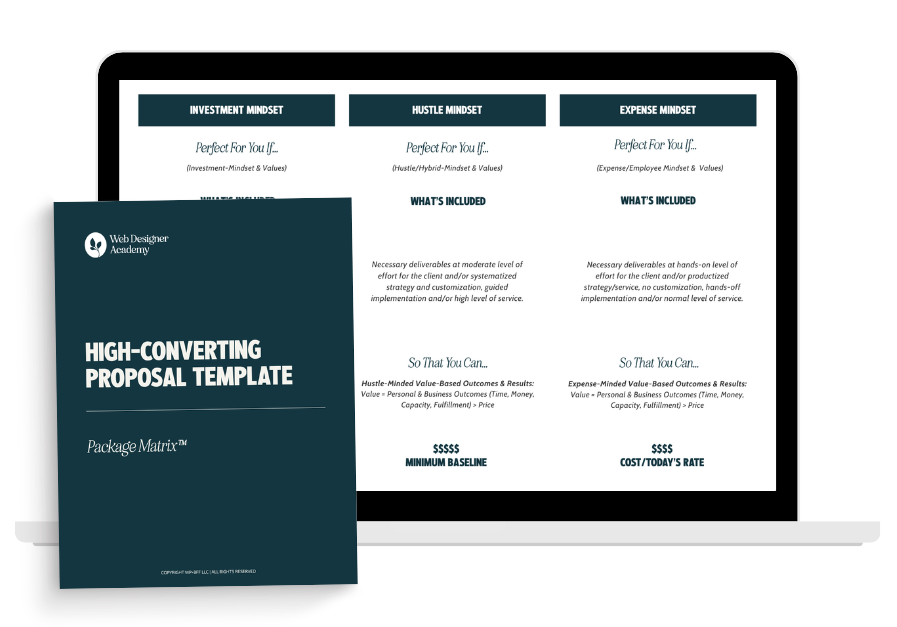
Your next proposal could be the one that changes everything. This free template shows you what to include (and what to leave out) to get more yesses at prices that feel worth it.
Discover the 5 subtle proposal mistakes even experienced web designers make that cost them thousands — and what to do instead.
Three signs a web design proposal process is setting clients up to make a cost-based decision instead of a value-based one: discussing budget or pricing first, leading proposals or packages with lists of deliverables, features, and functionality, and lowering the price right before sending the proposal. Each signals that the designer sees the website as a cost to the client rather than a revenue-generating asset.
You have so much more influence than you think around how clients make decisions to work with you. Here are 3 signs that your proposal is setting your client up to make a cost-based decision (how much can I get for the lowest possible price?) vs. a value-based decision (are these outcomes worth more to me than the price?)
You discuss budget or pricing first.
This happens in a lot of different ways… but the most common ones are on the Book a Call form on your website, you either have an open-ended question like “What’s your budget for this project” or some ranges they can choose from… or maybe you have “starting at” prices listed on your website, or you ask what their budget is for the project on the consultation call.
And it makes total sense on the surface, like, why waste your time on a consultation and proposal if they can’t afford to work with you?
But what you might not realize is that you’re priming your prospect to make a decision based only on price before you’ve ever put a proposal in front of them, no matter how much value is in it for them.
Your proposals or packages lead with lists of deliverables, features, functionality.
You’re confident you can deliver on everything that’s on the list in your proposal because you’re in control of all of it. And you leave it to the client to infer what the outcomes and results could be, and how those deliverables will create value for them, because you don’t feel like you have control over that part, and you don’t want to be responsible for things you can’t control.
You’d rather underpromise and overdeliver… which is a sign that you haven’t yet made that shift from seeing a website as a product or service your client buys from you to seeing it as a revenue-generating asset you create for them that helps them create more time, money, capacity and freedom in their lives.
You lower the price right before sending the proposal.
Lowering your price before you hit send is a tell-tale sign that you’re not sold on the value of what you do for your clients, and that you think price is the only reason someone would say yes or no. You feel responsible for making sure that your pricing is low enough so clients can afford to work with you. You’re making the price the most important thing.
If you think of what you do as a cost to your client, something that takes money from them instead of something that creates more money (and time and value) for them, that will come through in every aspect of your proposal, resulting in clients say no, ghost, or push back on your price.
Each sign should be 2 to 3 sentences: what it looks like, why it happens, what it signals.
Lowering your price before you hit send is a tell-tale sign that you’re not sold on the value of what you do for your clients, and that you think price is the only reason someone would say yes or no.
Shannon Mattern
Web designers don’t need more experience or confidence to charge more. They need to strategically re-order the consultation and proposal process so clients consider the value of possible outcomes before price is discussed. Use the proposal to show what the deliverables will empower the client to do, the cost of not moving forward, and the results possible from working together. It’s not a mindset shift, it’s a learnable skill.
Just like you strategically design a website for conversion, you can also strategically design a proposal for conversion.
Your proposal’s job isn’t to prove you’re the best candidate for the job, it’s to show the client what’s in it for them if they move forward, and what’s at stake if they don’t.
And you don’t need more experience or confidence – you simply need to strategically re-order how you move through the consultation and proposal process so that you prime your client to think about the value of the possible outcomes and results of working with you before price is ever discussed.
It’s to stop trying to sell yourself, your skills and a list of deliverables in your proposal, to stop trying to prove to clients you can deliver by pointing to what you’ve done for other people and instead use your proposal to show them exactly what the deliverables, features and functionality you’ll build for them will empower them to do, and why it matters to them.
It’s to use your proposal to help your client understand the costs of not moving forward, meaning, if they keep doing things the way they’re doing them, what is it costing them in terms of time, money, capacity, impact, fulfillment?
It’s to use your proposal to design an entirely different decision for your client.
It’s not a mindset shift – it’s a learnable skill.
You don’t have to work up the courage to charge more, you simply need to restructure your proposal to shift the decision you’re asking your client to make from price to value.
When you stop making your proposal all about you and start making it all about your client and what’s possible for them, that’s when you stand out from all the other web designers out there offering the same thing you as you who are just as good.
Design a different decision, get a different outcome.
It’s not a mindset shift - it’s a learnable skill.
Shannon Mattern
Get Instant Access
If you want to see what this looks like in practice, our High-Converting Proposal Template shows you the proposal structure that positions you as a strategic partner and frames a value-based decision instead of a cost-based one so that you can sell more projects at higher prices.
If you want to understand the deeper patterns that keep web designers undercharging, hustling and overdelivering, and what to do about it, get our free training all about the 5 proposal mistakes that cost even experienced web designers thousands.
Raising web design prices doesn’t fix the real problem because the price was never the problem. The structure of the proposal is what sets clients up to make a cost-based decision, and that doesn’t change when the rate goes up. Web designers who redesign their websites and raise their rates without restructuring the proposal often hear that projects are still “outside of our budget.”
Clients say a web design project is outside their budget when they don’t clearly see how parting with the price will help them create many times more than that in the future, in dollars, time, capacity, and physical, mental, and emotional health. They aren’t looking for evidence that the designer is worth it. They’re looking for evidence that the outcome will be worth it.
A value-based web design proposal frames the price as a fraction of the value the client will receive. Instead of asking “Are these deliverables and features worth this price?” it primes the client to ask “Are the outcomes I’ll experience in terms of time, money, and capacity worth more to me than this price?” The proposal shifts the question from “How much will this cost me?” to “How much can this make me?”
Three signs a web design proposal is setting clients up to make a cost-based decision: discussing budget or pricing first, leading proposals or packages with lists of deliverables, features, and functionality, and lowering the price right before sending the proposal. Each signals that the designer sees the website as a cost to the client rather than a revenue-generating asset.
Strategically re-order the consultation and proposal process so the client considers the value of possible outcomes before price is discussed. Use the proposal to show what the deliverables, features, and functionality will empower the client to do, the cost of not moving forward, and the value of working together. It’s not a mindset shift, it’s a learnable skill.
Web Designer Academy students have charged double, triple, and even five times more than they were before, without changing anything else about their web design business except their proposal process. Designers don’t need more experience or confidence to charge more. They need to restructure how the proposal frames value.
