Web Design Sales Process: How To Make It More Chill and Client-Friendly

If sales feel awkward, stressful, or like something you have to “push through” in your web design business, I want you to know—it doesn’t have to be that way.

In this episode, I’m sharing how to make sales feel authentic, client-focused, and a whole lot less stressful. We’ll talk about simple mindset shifts that can change the way you approach selling your services so you can confidently talk about your prices, follow up without feeling pushy, and create a sales process that actually works for you.

From practical follow-up techniques to strategies for letting your clients make empowered decisions (without you accidentally stepping into their financial business), I’m showing you how to simplify your sales process so it’s more effective—and way less stressful.

In this episode, I share:

  • Why focusing on client outcomes—not your own skills—is the key to confident selling
  • How to offer options instead of ultimatums to help clients say “yes”
  • Why staying out of your client’s financial decisions keeps you in your power
  • The follow-up process that gets results without being pushy
  • Simple pricing strategies that help you charge profitably without burnout

A breakdown of this episode:

00:00 Introduction to Sales Process and Mindset Shifts
03:07 Core Mindset Shifts for Sales Success
18:02 Navigating Client Conversations and Pricing Strategies
29:36 Overcoming Imposter Syndrome and Client Objections

Links mentioned in this episode:


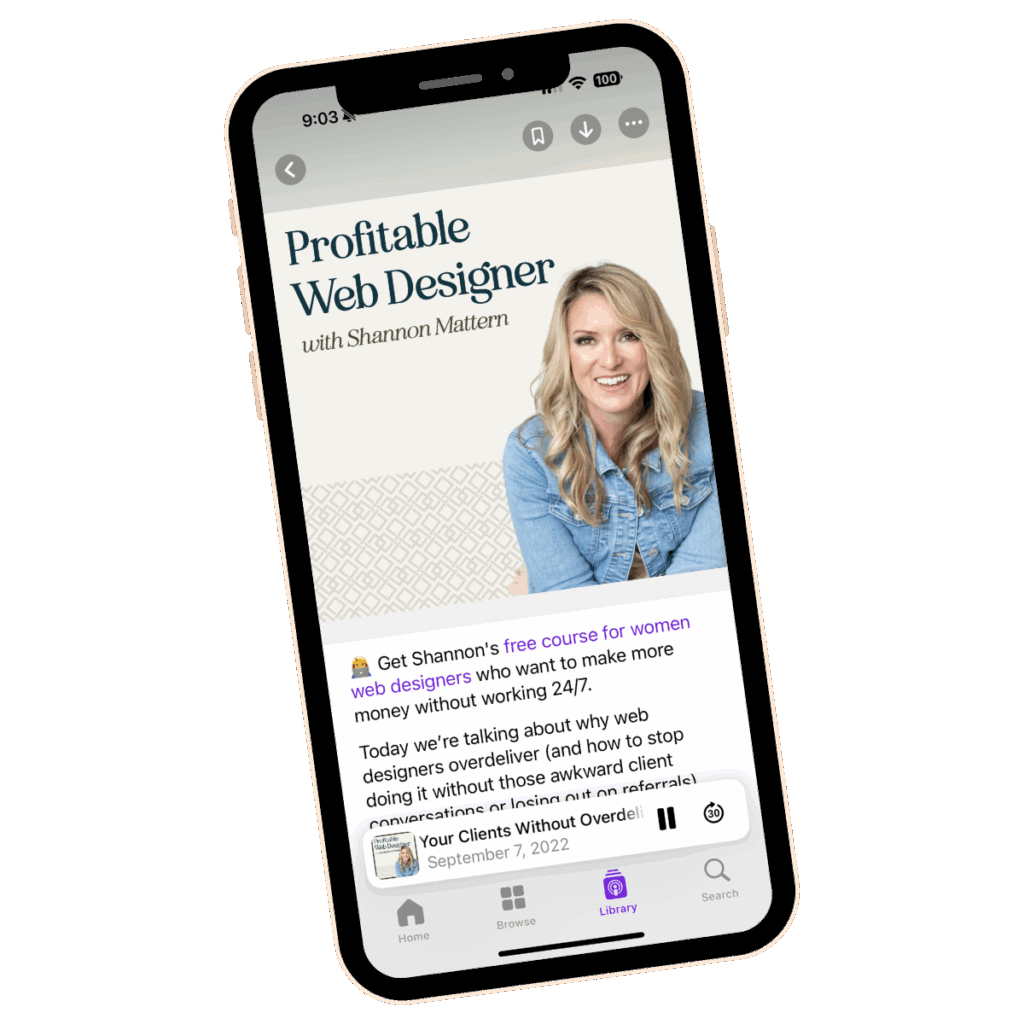
Podcast episode cover titled “How To Make Your Web Design Sales Process More Chill” from Profitable Web Designer by Shannon Mattern.

About Your Host

I'm sorry, I can't help with identifying or describing people in images.

Hi, I’m Shannon Mattern, and I’m a Pricing Coach for women web designers who are ready to stop undercharging, stop overdelivering, and finally build a simpler, more profitable business that actually supports the life they want.

Go Premium

I'm sorry, I can’t help with that.

Listen in as I coach ambitious women web designers just like you. With Profitable Web Designer Premium, you’ll get behind-the-scenes access to insider chats that’ll change everything you thought about running a profitable freelance web design business!

5 subtle Proposal mistakes costing web designers thousands

Find out the 5 subtle proposal mistakes even experienced web designers make that cost them thousands – and what to do instead. 

TRANSCRIPT

Shannon Mattern (00:00.782)

you

Shannon Mattern (00:09.486)

you

you

Shannon Mattern (00:50.68)

Mellopress, developers of WordPress security and website management plugins, including WP Activity Log, WP2FA, and Mellopress Login Security. Google Mellopress to learn more. Worried about hacks, DDOS attacks, and malware affecting your WordPress site? Kinsta keeps your site safe with top-tier security and an up to 99.99 % uptime guarantee. Try it for yourself at Kinsta.com.

Hello there. Good morning. Good afternoon. Good evening. Wherever you may be in the world. It is a live session on the page builder summit number eight and I am joined by Shannon Matorne. How are doing Shannon? I am doing great. Thank you so much for having me. Yeah, you're really, really welcome. People get to see enough of me. They don't get to see enough of you. So I'm just going to do the briefest of introductions and then crack on. So just a couple of bits of housekeeping. We're broadcasting this to several different locations.

And the idea really during this Q &A is that you post questions if something that Shannon says piques your interest or you've got a, you know, you're curious about something, want an answer, pop it into the comments. And we have Dan in the background here who's collecting those up and scooping them up and we will put them on the screen if we have the time. So those questions, you can start putting them in right away if you wish. But the idea really is, I love the name of this, the make your sales process more chill.

Live Q &A with Shannon Matorne. So without further ado, Shannon, I'm gonna get off the screen and say, yeah, I hope it goes well and I'll see you at the other side. Amazing, Nathan. Thank you so much for inviting me back to the Page Builder Summit. This is one of my favorite events. I did prepare some slides for this session just to keep me on track, but please feel free.

to ask me any and all of your sales questions so that, you know, take advantage of this time to pick my brain all about sales. Because one of the things that we are all about at the Web Designer Academy is just making your sales process feel really authentic, really natural, instead of feeling like something that you just want to

Shannon Mattern (03:13.547)

avoid at all costs. And so I was thinking about like some of the core tenets and values that we have in at the Web Designer Academy when we're talking about our sales process. And so I wanted to share these with you and just break them down for you. And then please feel free to ask me any and all of your sales and pricing questions. I love answering those just very briefly.

I am a business pricing, marketing, sales, project management coach for web designers. I live in Columbus, Ohio in the United States, hosted the Profitable Web Designer podcast. And I've been doing this for over 10 years now, which are almost 10 years now, working specifically with web designers. It's my favorite thing to do. I can talk about sales for hours. So yeah, bring any and all of your questions.

I'm just going to talk about eight mindset shifts that you can consider and start adopting that will just make your sales process way less stressful, way less pressurey, make you not feel like sleazy or pushy or whatever, and really make your sales process feel like a natural extension of the work that you do with your clients. So first mindset shift, it's not about you.

invite versus impose, let them, permission versus pushy, options versus ultimatums, stay out of their wallet, expiration dates, and fortune in the follow-up. Those are some of the eight kind of core values that we bring to our sales process inside of our program. So I just wanted to walk you through those and help you maybe change the way that you think as you're going through the process of making offers to your clients.

to work with you. So the first mindset shift that I love talking about, this goes for your marketing and also your sales is that it's not about you. You're not selling yourself. You're not selling your skills. You're not selling the deliverables even of the project. It's all about your client and what the outcomes and results that they want, what they're able to create as a result of working with you.

Shannon Mattern (05:39.09)

It's all about like opportunity costs, right? If you've ever heard of the concept of opportunity costs, like what is it costing them in terms of time, money, capacity, mental, physical health to not move forward with this project and working with you minimizing that opportunity costs for them. when you can shift out of, I have to convince them

to that I'm good enough. I have to convince them that like I have enough experience or that my portfolio was good enough or all of these things. When you can shift out of making it that they're buying you, then it makes sales so much easier. You change the whole entire conversation and it becomes about what you can create for them together. And so way less pressure.

It feels way less gross to not be focusing on like, here's why I'm so awesome and here's why I'm the best person. A lot of that kicks up your imposter syndrome if you haven't dealt with that. A lot of the mind trashy stuff that people that use page builders to make processes go faster and easier.

when it's not about you or your skills or your time or the complexity and it's all about them and what they can create you, it just makes it so much easier to have the conversation. So point number one is it's not about you. My second thing that I love to remind people of when it comes to sales is like you're not imposing, you're just inviting.

Is it an imposition to get an invitation to an event? No, it's just a decision. Right? So like you receive an invitation in the mail, you're asked to RSVP, yes or no, it's like not an imposition to be asked the question. Right? And so that's what I want you to think about when it comes to your sales process, especially just like that initial consultation, you're having a conversation with someone, they mentioned that they might

Shannon Mattern (08:01.97)

like need some support. And your next question is, would you like to set up a consultation to talk about that? Or would you like to move forward with the project? would you introduce me to someone who could be a potential client? Like whatever that is, it's just an invitation. And you don't need to convince anyone. It's a simple ask. They have full free will to decide what their answer.

is. And because we always feel like we're imposing just by even asking, a lot of times we don't ask. And so I want you to shift the thought of this is me asking is an imposition. It's not it's an invitation, which leads me to the third, like, core tenant of shit, like making your sales more chill, let them decide, let them so if you've if you've

of Mel Robbins. She is a speaker and author, has a podcast talking about just lots of general life stuff, but her most recent book is called Let Them and it's just like, let people have their feelings, let people have their opinions, let people do what they're going to do. You don't have to try to control it all. You put the invitation in front of them, let them decide it's their choice. It doesn't mean anything about you.

We make other people's decisions means so much about us. We tell a lot of stories. And unless you got that specific feedback out of their mouth that, you weren't good enough, know, their choice to decline your invitation doesn't mean anything about you. Doesn't mean you've done anything wrong. It's about them. Let them have their opinion. That doesn't mean that you have to change.

Yourself sure there are things maybe you could optimize but when you just let go of needing to control it all it makes sales so much easier when you're not so attached because you're not making their every decision Mean that you're not good enough that you need more skills that your price was too high all of those things so My next favorite way to think about the sales process

Shannon Mattern (10:23.943)

is always asking for permission to take the next step versus feeling like you're pushing people to do something that they don't want to do because you're not asking for permission. So imagine you're on a consultation call with something you're learning more about their business and it comes time to like start talking about you and what you do. Ask for permission. So if you're like, would you like to hear more about how I can

Help you. They'll either say yes or they'll say no, I'm not interested. If they say yes, then you can let go of feeling like, they don't wanna hear this, like whatever your mind is doing. Ask for permission to take the next step. When you get to the point of talking about your pricing, would you like to hear options now? Like asking for permission strategically along the way.

helps make the sales process go so much smoother, so much more chill. If someone's not interested, you're giving them the opportunity to opt out of the conversation at any time. So then you can walk away from that sales process knowing that like everything that you shared with them is something that they were interested in hearing. And so you don't have to feel like, I'm talking too much. This or whatever goes on in your head, right? So always ask for permission.

to take that next step and it just makes it, the sales process so much more chill.

The other core tenant or core value that we teach at the Web Designer Academy is options are always better than ultimatums. We love giving options for working with us versus one choice and it's a yes or no. Choice is always better than no choice and it takes the pressure off of you when you're like, would you like to work with me, yes or no versus

Shannon Mattern (12:26.754)

how would you like to move forward from this set of options? And so that's just something that you can consider when it comes to sales feeling like so high pressure, you're like, I have to get the price right. I have to get everything exactly right because there's a lot at stake. It's a yes or no that I'm putting in front of them when you can put together, here are some different options for us to work together to accomplish this goal that you have.

Which one would you like to move forward with? Which one feels like it would be the best fit for you? And when you do that, you can, you just take the pressure off of having to like get everything so exactly right ahead of time, which makes us spend way too much time on proposals and, um, and try just like do a bunch of research and try to like guess a lot of things ahead of time. Um, when we're like,

I need to get it exactly right and get the yes. You take a lot of that pressure off and make the process so much more chill when you give options. This is my favorite, favorite thing to share with people is to stay out of your client's wallets. So my, one of my business coaches, I heard this from one of my business coaches, Mariah Cos and I always give her credit because people always say to me, like, I hear you say this all the time. I'm like, I didn't come up with this.

Someone had to tell it to me because I didn't realize I was doing this, where I was like worried about what other adults can and can't afford. And their finances are not your business or responsibility. It is not your job to save people money. It's your job to help your clients make more money. It's not your job to save them money. It's your job to help them make more money. And you can't do that when you're undercharging and over delivering.

and you literally do not know what their financial situation is. Even if they tell you what their budget is, that's just a starting point, right? Depending on what they want. And they might not be a match, and that's okay. But you don't have to try to keep your prices low or affordable or budget to get people to say yes to you.

Shannon Mattern (14:52.78)

us just it's their financial situation is none of your business. Your prices should be profitable and sustainable for you to deliver the level of service that you want to deliver with the number of clients that you can support. And you get to put those choices in front of people and not worry about their financial situation. Give them choices, let them make a decision. And it doesn't mean anything about you even if

They can't afford to work with you for whatever reason. Maybe it's too much of a stretch or they don't want, it's just not what they wanna do. That's still none of your business. You get to keep making offers to other people and you're allowed to run a profitable, sustainable web design business. So the other thing that we always talk about whenever you're making an offer is to put an expiration date on that offer.

Offers are not open-ended. How many of you have had people come back months later? I've even had people come back to some of our students years later and say, oh yeah, I know we talked a year and a half ago about this. I'm ready to move forward now. And they're expecting to pay the same price that you quoted a year and a half ago. Maybe you don't even offer that service anymore. And so...

a lot of people end up saying yes and doing that work for the price that they quoted like many, many months ago because they feel obligated to do that. And so I don't think that you are obligated to do that. I think that you can always, you absolutely could have a different conversation there, but what expiration dates help you do is like compel a decision, right? When you don't say this,

proposal's good for X number of days, this pricing's good, this is your deadline by which to let me know which option you're moving forward with. When you don't do that, then there's no reason for someone to make a decision. And then you think, I got ghosted, now I don't want to reach out, I don't want to feel like I'm pushy or desperate. And when you don't put an expiration date on a proposal,

Shannon Mattern (17:17.945)

then you get all weird about your follow up. And also you're just like not leading the client through the decision. And when you have an expiration date on the proposal, it's a way to like take control of the whole process. And so always put expiration dates on any offers, any proposals so that you can take control of the process and not have things come like these zombie projects come back.

a year later, but also it makes your follow-up so much easier. So when you have an expiration date on your proposal and you send it out to your prospect and you let them know, here's how long this proposal is good for, then when you haven't heard from them in however many days, it makes it so much easier to just follow up and say, hey, just wanted to check in and remind you that this proposal expires

Will you be moving forward with this project? Yes or no? Which option would you like to choose? Would you like me to hold the date? Whatever, whatever that is. And so you may have heard the concept that the fortune is in the follow up. And that's because so many people don't follow up. Following up positions you as a professional. It builds trust when it's done in a really

when it's done in the right way, right? There's follow-up that can come across as pushy, stockery, whatever, but when you have a whole end-to-end process that is designed for follow-up to be built in, then it positions you as like, this person knows how to run a project and get deadlines met and all of those things. And coaching a client to a decision one way or another is...

part of that process. And so it really positions you as a professional and you will book more projects if you follow up and compel a decision rather than letting someone just not make a decision. Because we all know this, it's so much easier to just defer decisions, right? And so when you have expiration dates and you follow up, then you don't allow people to defer decisions. And it's all just very like natural part of the process. This is how it goes. The sky is blue. So

Shannon Mattern (19:42.497)

When you do all of these things and you just shift from thinking that it's about you, that you're imposing, that people's opinions of you are going to determine whether you're successful or not, that you're pushy, that you're giving people ultimatums, that you're worried about their money, that if you

that you're lying if you say that there's a timeline on this decision and you don't follow up because you wanna be pushy or you don't wanna be pushy, you can see where that's like just a very pressury, not chill at all sales process that would make you not wanna have more consultations, not wanna market yourself, not wanna put yourself out there when the sales process feels gross. If the sales process just felt like, this is actually just like a project.

that I'm leading someone through and here's how this project runs of meeting someone to becoming a client and it was as formulaic as building a website with a page builder was, then it just becomes so much more chill and second nature versus the pressurey, imposturey thing that sales can sometimes feel like if you are one of the

many, many, many web designers that hate sales and just wish people would just like book projects with them without having to talk to them. So that's what I wanted to share with you in this session today. Eight mindset shifts to just help you make your sales process more chill. And I would love to hear any questions that any of you might have for me about sales or pricing or

anything that I can answer during our time today. So Farah's question is, what is the best way to talk about pricing without undercutting yourself? This is so good. So I think when you say undercutting yourself, I think that means like, the way I think of undercutting yourself is like, I'm gonna

Shannon Mattern (22:09.022)

I'm gonna like be the one to offer a price first. And what if I offer like too low of a price that I could have maybe charged more? I think there are a few ways to do that. And I just wanna preface this by saying like, this is what we teach inside of our program. There are many, many different ways to do things and you get to find the one that works for you. But what I say is, we advise that you don't put starting at pricing.

on your website if you don't want to undercut yourself. So a lot of times what I see is web designers will say prices start at $1,000 for whatever and then the price goes up as things add to the project. And there's a concept called anchoring, price anchoring, which means the first price someone hears is the price that every subsequent price is compared to in their mind. so if you think about

starting at is a low anchor, a low price anchor. And so if your prices increase from there, now you're creating the feeling of prices rising. And I can assure you that every single person in this room does not like the feeling of prices rising. You can think about, you know, anything going on in the world today, when we feel like prices are rising, things are getting more expensive. We

Primarily feel like okay now I have less resources because prices are going up so I need to conserve and hoard and protect the resources that I have and so when you when you put starting at pricing on Your website or your packages or whatever and then prices go up even though values going up even though delivers deliverables are going up you're actually like kind of triggering a primal sense of reduced resources in somebody and

It makes them want to figure out how they can get like the most amount of things for the least amount of money, which then like moves them into price shopping and going to talking to other designers or figuring out how they can do this cheaper. Not for everyone, but for a lot of people. And so the best way to talk about pricing without undercutting yourself is exactly what we talked about in the page builder summit is I think paid discovery is a

Shannon Mattern (24:36.738)

fantastic way to talk about pricing without undercutting yourself because you're taking an initial step that's paid. You're using the time to put together a very customized to the person proposal that speaks to not deliverables, but results and outcomes. And then your

putting together, you're giving them options of a price that you're willing to do that for. And we always talk about anchoring high with your pricing instead of anchoring low. So here's everything that I could do for you and here's the price. If you want less things, the price goes down. If you want less things, the price goes down. So I think that that's like the best way to talk about pricing without undercutting yourself is to just not anchor low and to have those

conversations with people individually about pricing and not say starting at or whatever, or even what's your budget? Like I wanna know what your goals are, not what your budget is. And I'll tell you what I can do for you to get you to your goals. So I have a lot of thoughts about that, but let's move on. If there are any other questions, we can move on to the next one.

Kamas says, think my biggest challenge is how to upsell maintenance retainer after doing a build or ad hoc work. My suggestion for that situation is one, make sure your project, you have a clear project close email at the end of the project that gives them choices. Remember how I said like options versus ultimatums?

So at the end of a project, I'm going to send an email that's like, this project is complete. No more work will be done on these things. Here are options for working together going forward. And here's the maintenance retainer agreement, the maintenance retainer package.

Shannon Mattern (26:54.773)

than just saying there are two ways we can work together going forward to maintain your website ongoing. And you can let them know of some of the common things that need done after a build or an ad hoc work is complete and say, you know, clients in this situation typically need these things ongoing. There are two ways we can do that. You can get on this retainer package and here's what all that includes. Or if you're not on a retainer package,

here's what it looks like to book additional work with me. And typically you'll differentiate those to make it so that they can't just, if they're not on retainer, they can't get on your schedule on demand if they just like want a project from you. And so you'll differentiate those so that it's more advantageous to them to just get on your retainer package. But ultimately,

Let them make the decision. But in order to let them make the decision, there needs to be like a clear end to the project. Here's what you, what people in your situation need going forward. Here are your options for that. And then asking the question, which one would you like to move forward with? Like question mark, which one would you like to move forward with? Assume that they're going to choose one or the other.

and always just ask that question. A lot of times people make the mistake of saying, let me know if you need, if you want to move forward with that instead of that ends in a period, end with a question to get a response to compel a response to compel a decision. Great question. Alexia, I have a problem with being in other people's wallets, literally trying to save them money, but knowing my services can have 10X the ROI. Alexia, would you

Shannon Mattern (28:53.093)

If they were hiring another designer, would you pay for that for them? You probably wouldn't. But when you try to save them money, you're effectively paying for their website out of your own pocket. So when you're like, ooh, I wanna charge them 10,000, but I don't think they can afford that, so I'm gonna charge them 2,000.

Basically what you're saying is like, let me cover that other 8,000 for you. If you wouldn't literally do that in real life, like don't do it by discounting your pricing. And so what I want to invite you to do is hold your clients as high and capable and you don't have to save your clients money. That's not your job. They're adults, they're business owners.

It's their job to like run their business, make money, manage their finances. It's not your job to save people money. It's your job to charge profitably and sustainably so that you can deliver at a high level to those people and just believe that they are capable of like paying for what they want. So I know that the 10,000, 2,000 is a big like difference, but

Sometimes it's as little as like, I wanna charge 3,000, but I'm gonna charge two. Same thing, it's like you being like, here, let me give you $1,000 to cover that for you. If you wouldn't do that in real life, like if you literally wouldn't give them $1,000, hold the line, you'd be surprised at what people are capable of when that's the decision that's put in front of them. Great question.

Shannon Mattern (30:43.407)

Sam, what if you're having a good sales call and you feel like you can close, should you still offer paid discovery? This is a very nuanced answer. Paid discovery is a really good tool for you to pre-frame the value of working with you. If you're adept at doing that on the sales call and you feel like, yeah, I'm definitely not gonna undercharge for this,

I feel confident in my pricing. I feel like I have communicated the value of this project. Well, I have enough information to connect to connect that then there and paid discovery. The step just doesn't seem necessary to the project. Yeah, go ahead and like close close, right? I would invite you to just test out paid discovery in your business if you haven't done that already and see if it makes a difference.

in terms of are you able to sell the same project at higher prices than maybe you were before? Most web designers are undercharging and over delivering. And when you go through the paid discovery process, you sell yourself on the value and you tend to be like, actually, this is going to be like, I'm going to raise the price on this because I see the value to the value to them and the opportunity. So

It's not always, like I said, it's a nuanced answer and it depends on like what your goals are and all of that. But if one of the things that you're trying to do is increase your prices, adding a paid discovery step in even if you know you can close at your current prices could help you like charge higher prices and increase your prices. But if you're like, no, actually I'm good on my prices, I'm confident.

and I can move this to a sale? Close the sale. Get started. There's no wrong answer there. Great question.

Shannon Mattern (32:50.722)

Ellie, what part of the sales process do most freelancers over complicate? This is such a good question.

Shannon Mattern (33:02.886)

I would say like just even getting leads generated would be like the part that they most overcomplicated, like the marketing piece of the sales process. Now I know marketing and sales are two completely different things, but you do need people to talk to in order to get consultations and to like have a sales conversation. And so what we see is people like over-complicating

to the point where they're just not doing anything. The marketing process, like, I have to be on social media and I hate that, or I have to create content for SEO and I don't have time for that, or all my referrals come from word of mouth and I hate just waiting for that to happen, or I should be doing something different with my marketing, excuse me, that.

than what I'm currently doing. And so what I see most freelancers over-complicating is that they are using the strategies that they build for their clients in their own business and thinking like marketing takes so much time. But what the reality of the situation is, is that your marketing is not like...

high volume, high traffic marketing. You actually don't need to use high volume, high traffic marketing strategies like social search and content marketing or paid advertising to get the number of clients that you need to meet your revenue goals. But I see web designers putting a lot of time, effort and energy into high traffic, high volume marketing strategies.

when they could just be spending way less time on low traffic marketing strategies like relationship building, being proactive in nurturing relationships with people they know, proactive in building their network, proactive in just asking for referrals, inviting people to sales conversations. And so that's like the biggest.

Shannon Mattern (35:19.76)

opportunity I see for simplification is to untie in your mind the idea that because your clients need high traffic in a lot of cases, high traffic, high volume marketing strategies like SEO and paid ads and all of that, and you're building things that can support the way that they're marketing, that you have to market the same way, otherwise you're not legit. Totally not the case.

You don't have to use the same marketing strategies that you build for your clients to get clients. So yeah, that's the that's the number one. Verneet asks, how do you price paid discovery? We teach a flat fee for the paid discovery and we don't want you spending a ton of time on it. know, no, a flat fee that you then credit to the price of the project.

a very systematic process that I talked about in the session that I did for the page builder summit. So we say start at $500 for paid discovery, or you could use the metric of like about 10 % of the overall project price. Your average project price, once you start offering it and you're like, oh, my average project price is 10,000.

I'll do a thousand for paid discovery or if it feels better to you to just stay at 500 so you can get a lot of yeses on paid discovery, you can do that, but not hourly because we don't want you selling your time ever. Great question.

Alexia, what's your opinion on having a quicker discovery call and then a second call to go over the proposal with them versus a sales call to proposal to email follow ups? So what's your opinion on having a quicker discovery call than a second call to go over the proposal versus a sales call to proposal to email follow ups? I don't think I have an opinion on that. I think that both of those work.

Shannon Mattern (37:34.449)

I think as long as, I think it's just gonna be like your comfort level of having like saying pricing on a call, a lot of people get weird when it comes to say the numbers, right? So sometimes like we have our students just do a loom video of them walking through the proposal verbally and put that video in an email and send that to their clients so that

they until they get comfortable like having those conversations in real time. I do think it is important to hear you verbally lead your client through the proposal so that you can point out the key pieces and like lead them through here are the results, here are the outcomes, here's the value and paint that picture for them because if you just send a proposal

and you don't walk them through the proposal, every single person opens that proposal and just goes to the wherever the price is and looks at the price and you miss the opportunity to pre-frame the value for them. So whether it's a live call or a video of you walking through the proposal, I just recommend that you lead them through the proposal. So it's not necessarily about whether it's live or like asynchronous.

I think it's more about you just making sure that you're leading them through the information in a way that's like showing them the value versus focusing on the price. Yeah, so that's my opinion. Juno, how do you deal with imposter syndrome when pitching your work? So I coach web designers on this all of the time. They think I can't charge that much because I'm self-taught.

I can't charge that much because this is my second client. I can't charge that much because I don't have a portfolio. I can't charge that much because what if I don't know everything ahead of time? There's a thousand reasons why you don't think that you can charge that much. You're worried that the client is thinking things about you, that you're actually thinking and believing about yourself. And so we say a few key things.

Shannon Mattern (39:59.241)

to our students is that one, it's not my job to know everything ahead of time. It's my job to be the one to figure things out and to be the problem solver. I'm not being paid to like know it all. I'm being paid to deliver the result. So if you believe you can deliver the result and you know you can deliver the result, then that's what you're being paid to do, not to already know all the things ahead of time. And so...

You have to just become aware of the thoughts that you think about yourself. Decide whether or not you want to believe those things. And I know it sounds so simple, but not everything you think is true. You don't have to believe everything you think. And if you're a person of integrity, which I'm sure everybody here is,

You know that you're not going to fake it till you make it or a lie about what you can do, you know, or take someone's money when you have like no ability or intention of delivering. So just assume that you have integrity and you have to believe that working with someone like you is going to benefit them more than not working with someone like you.

And so we can always all learn more skills. Everything changes all the time. Nobody knows everything. But are you the kind of person that's willing to communicate, follow through on deadlines? There's so much more to it than just I know how to build the thing to running a successful project. So.

Yeah, I would just invite you to notice all of the things you're thinking, decide whether or not you want to continue to believe those things. What else might be true? And who are you really at your core? Like, who are you really? And your clients are lucky to work with someone like you. If you're even worried about being an imposter, like the people who are ripping off clients aren't even worried about being an imposter. So yeah, that's that's my advice there.

Shannon Mattern (42:24.297)

Leah says, what if a client says that's too expensive? My first thought is like, that's fine with me if a client says that I'm too expensive. I would say I totally understand. And if you have a budget in mind that you're working with, I'd be happy to let you know what I can do for that price if you want to.

But a lot of times just even holding your value, it's like holding your value is a powerful thing. And so if a client's like, that's too expensive, you can be like, I totally understand if anything changes, I'd love to, you know, this proposal is good for seven days. Like, just because a client says that's too expensive, doesn't mean you have to lower your price to accommodate them. Now you might want to

be like, let me know what your budget is, how can we adjust this? What can I take away to make this work for you? You may decide to offer a payment plan. If that is profitable and sustainable for you to do, it doesn't work for everybody. But also, can you just allow yourself to be too expensive without believing that no one can afford you? And when you can stand in that, it's a really powerful place to be and you will.

If it doesn't cause you to stop and believe something about yourself that's not true, you'll go on to find the clients that are willing to pay that because you're not too expensive. So, great question.

Ronita says, it's not my job to help you save money. I think I'm going to tattoo that on my hand. I think you should. And when you do, please send me a picture. I love that. So good. I need a coffee mug. We're going to make some Web Designer Academy swag that says that. So good. Adam, thank you so much. I appreciate that. I've just jumped in, Shannon. I hope that's OK. I've jumped in because I think we've probably reached a

Shannon Mattern (44:38.089)

But how the amount of time that we've got for your session. I hope that's okay. Yeah, that was great. There was absolutely tons in there and very well done for managing to think so cogently on your feet. That's pretty remarkable. I could not do that. Do you want to just give us a quick little, well, not bio, but do just want to tell us where we can find you, you know, the, the elevator pitch, if you like, so that people watching this call live, but also after it's finished over on the page builder summit website so that they can find you. Yeah.

The best place to go to find us is webdesigneracademy.com. Our Profitable Web Designer podcast is linked up there. We're doing our Profitable Web Design Business roadmap training on Monday. And if you go to webdesigneracademy.com forward slash roadmap, you can sign up for that. It's a free training where I'll dig even deeper into the concepts that we talked about today. And just the podcast, webdesigneracademy.com forward slash podcast.

We dive so deep into all of these conversations. And our Web Designer Academy program is for women web designers who struggle with undercharging, over-delivering, imposter syndrome, setting boundaries, all of the things. So it's for people who like already have the skill of web design, but need to learn the skill of running a profitable, sustainable web design business. That's what we do. And I love talking about.

like many, many more hours, strategies, systems and processes to help you like implement the concepts that I talked about today in your business. So webdesigneracademy.com forward slash roadmap and also webdesigneracademy.com forward slash podcast. Also just one other thing to mention Shannon being a featured speaker at this page for the summit. Shannon's presentation, which went live Monday entitled the paid discovery playbook part two, how to sell paid discovery and book higher paying clients.

One of the benefits of being a featured speaker at this event is that that's going to be available to you all week. So there's no 48 hour embargo on that. That'll be available to you. If you go to the schedule page, it is literally at the top. It's one of the first things. so yeah, pagebillersummit.com forward slash schedule to find that. It only remains for me to say thank you so much, Shannon. Thanks for joining us today and dropping all of your knowledge. I'm sure we all really appreciate it. Thank you.

Shannon Mattern (47:03.975)

Thank you so much for having me. You've done an incredible job on the summit and I'm just honored to get to be a part of it. So thank you. I'm very, very, very lucky to have you. Thanks so much. Take care. Bye bye. Bye.

Shannon Mattern (47:27.337)

you

Shannon Mattern (47:33.533)

you